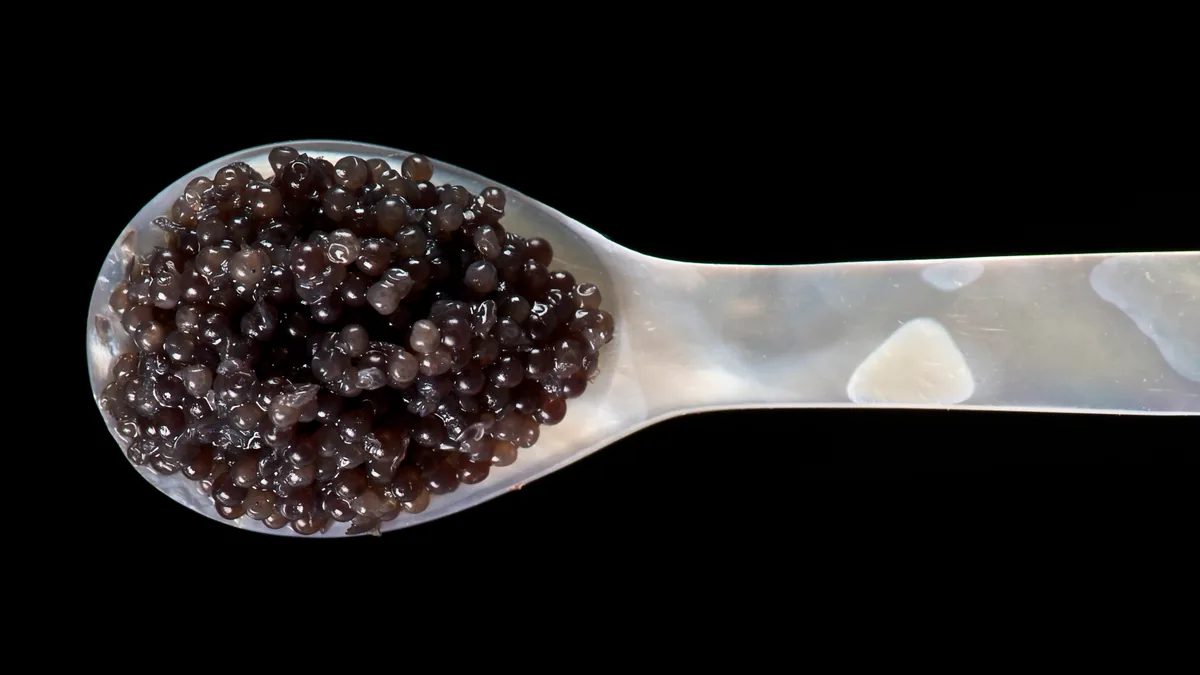
Buying caviar online is mostly a question of trust: you cannot see the tin or check how the parcel was kept cold. What you can check is the label, the seller's information and how the order arrives. This guide explains the species names you will see, what "grades" do and do not tell you, how the international CITES labelling system works, and how to handle a delivery and store it.
What counts as caviar
In the United States, the Food and Drug Administration's compliance policy on the word is short. The term "caviar" on its own "should be applied only to the article prepared by the special method (salting) of sturgeon roe". Roe from other fish may be labelled "_____ Caviar", with the blank filled in by the common name of the fish, and all words in the name should be in type of "substantially the same size and prominence". The same policy notes that no standard of identity has been set for caviar, so the label should carry an ingredient list, and that colouring is allowed if the label declares it prominently (FDA, CPG Sec. 540.150).
So caviar websites sell three kinds of product:
- Sturgeon caviar: salted roe from a sturgeon species. This is what the plain word means.
- Named fish roe: salmon, trout, whitefish, lumpfish and similar, sold as "salmon caviar" or "trout roe". Often much cheaper.
- Imitations: lookalikes made from ingredients such as seaweed or oil.
WWF's guide to the legal caviar trade warns that substitutes and imitations "are often fraudulently sold as originating from sturgeons", and that roe from non-sturgeon fish is not covered by CITES because those species are not listed (WWF, Sturgeons and Caviar). If a page says only "black caviar" at a suspiciously low price, read the ingredients and species before ordering.
Species: the name that matters most
The species matters more than any brand name. WWF notes that it is "almost impossible to determine the species of origin simply by looking at the caviar", because grain size and colour vary with age and within a species; only DNA analysis can settle it. That is why the species should be printed on the tin and on the product page, ideally with the scientific name.
Names you will often see, with the scientific name and the three-letter CITES code used on labels (from WWF's species table):
- Siberian sturgeon: Acipenser baerii, code BAE.
- Russian sturgeon, usually sold as osetra or oscietra: Acipenser gueldenstaedtii, code GUE.
- White sturgeon: Acipenser transmontanus, code TRA.
- Kaluga: Huso dauricus, code DAU.
- Amur sturgeon: Acipenser schrenckii, code SCH.
- Sterlet: Acipenser ruthenus, code RUT.
- American paddlefish: Polyodon spathula, code SPA. Also covered by CITES.
- Beluga: Huso huso, code HUS.
Hybrids are common in farmed caviar. CITES writes them as the male's code, an "x", then the female's code, so a hybrid label shows two codes rather than one.
A note on beluga for US buyers
The US Fish and Wildlife Service explains that beluga sturgeon is listed as "threatened" under the Endangered Species Act and that, under a moratorium, "beluga caviar cannot be imported into or exported from the United States in any quantity", even though it may be traded elsewhere with CITES permits (US Fish and Wildlife Service, Caviar and Passengers). The fact sheet is older, so check the Service's current position. Products called "beluga hybrid" or similar are a different thing from Huso huso caviar: the label codes tell you which species are actually involved.
Grades, "malossol" and other words on the tin
There is no official, government-defined grading scale for caviar in the US; as the FDA policy above notes, caviar has no standard of identity. Words like "royal", "imperial", "reserve" or "grade 1" are the seller's own descriptions. They can rank tins within one seller's range, but one seller's "imperial" cannot be compared with another's.
More useful words:
- Malossol is Russian for "little salt". Imperia Caviar, one seller, describes 5% salt as the upper limit for malossol caviar, with many buyers preferring around 3.7% or less (Imperia Caviar, Malossol). Salt content is a seller's claim, not a regulated term.
- Pasteurised caviar has been heat treated and usually keeps longer unopened. Fresh, unpasteurised caviar is the more common premium product and has a short life. The product page should say which it is.
- Pressed caviar is a dense paste made from damaged roe. WWF notes that it is the only form in which CITES allows caviar from different species to be mixed in one container.
- Farmed or wild: WWF reports that more than 95% of caviar in legal international trade comes from aquaculture, because trade in wild-caught caviar is not allowed from most areas of origin. Most caviar sold online is farmed, and the CITES label says so.
To compare tins fairly, compare species, origin, date, salt level and price per gram. Brand words come last.
How to read the CITES label
All sturgeon and paddlefish species are protected under CITES, the Convention on International Trade in Endangered Species, and international shipments generally need CITES permits (US Fish and Wildlife Service). On top of permits, CITES members agreed a universal labelling system for caviar. WWF's guide sets out how it works:
- Every primary container (the tin or jar touching the caviar), whatever its size, must carry a CITES label. This applies to wild and farmed caviar, to all species and hybrids, and to domestic as well as international trade.
- The label must be non-reusable and must either seal the container or make any opening visible. It should not be possible to remove it undamaged or move it to another tin.
The code is a string of six parts, in this order:
- Species code: three letters, such as BAE or GUE, or two codes for a hybrid.
- Source code: W for wild-harvested, C for bred in captivity, F for a female born in captivity with at least one wild parent, I for confiscated or seized caviar.
- Country of origin: a two-letter ISO country code.
- Year of harvest or repackaging.
- Registration code of the processing or repackaging plant, issued by the national CITES authority. If the caviar was repackaged in another country, that country's code is built in.
- Lot number, linking the tin to the plant's tracking records or the export document.
So a tin of farmed Siberian sturgeon caviar starts BAE/C/, followed by the country, year, plant code and lot, separated by slashes. WWF's brochure has worked examples.
Two practical points. First, ask the seller for the code before you buy, or look for it in product photos; a reputable seller can tell you the species, source and country. Second, a label is a starting point, not proof. WWF reports that market surveys and DNA testing have found mislabelled caviar for sale, including cheaper caviar sold as more expensive types. Prefer sellers that state the species, origin and code plainly and answer questions.
Shipping: what a good delivery looks like
Fresh caviar is perishable and is normally shipped overnight with ice packs. Before ordering, check:
- Which days the seller ships, so the parcel does not sit in a depot over a weekend.
- Whether someone needs to be home, and what happens if a delivery is late.
- The seller's policy if the order arrives warm.
The US Department of Agriculture's Food Safety and Inspection Service advises that perishable mail-order food marked "Keep Refrigerated" should be opened and checked straight away. It should arrive frozen, partly frozen or at least refrigerator cold, below 40 °F measured with a food thermometer. If it arrives warmer than that, notify the company and do not eat it, or even taste it (USDA FSIS, Mail Order Food Safety).
Storage once it arrives
Caviar sellers recommend colder storage than most home fridges manage, and their advice differs, so follow the instructions and date on your tin. Two examples:
- Imperia Caviar recommends 28 to 32 °F, notes that home refrigerators tend to run around 36 °F, and suggests refreezing the ice packs and keeping them with the tins in the coldest part of the fridge. It recommends eating unopened tins within a week of delivery, says properly stored unopened caviar lasts up to three weeks, advises finishing an opened tin within 48 hours, and does not recommend freezing the caviar (Imperia Caviar, How to store caviar).
- Marshallberg Farm, a North Carolina producer, gives 23 to 36 °F for unpasteurised caviar, says the back of the bottom shelf is usually the coldest spot, recommends eating it within a month and following the "best used by" sticker, and suggests that a layer of plastic wrap on the surface can keep an opened tin an extra day or so. It says vacuum-sealed tins can be frozen with little effect, but opened caviar should not be (Marshallberg Farm, Caviar Storage Instructions).
Pasteurisation, packing and tin size all change shelf life, so the tin's date and the seller's instructions win over any general rule.
When a cheaper option is enough
Not every occasion needs the most expensive tin. Where roe is a garnish, a small tin of a farmed sturgeon species, or clearly labelled salmon or trout roe, may do the job for much less. Buy only what you will finish within the seller's opened-tin window.
Checklist before you pay
- Is it sturgeon caviar, or named fish roe? Check the product name and ingredients.
- Which species, with the scientific name, and is it a hybrid?
- Farmed or wild, and which country? The CITES code should confirm it.
- Fresh or pasteurised, and what is the date on the tin?
- Price per gram, including overnight shipping.
- Shipping days, delivery address rules, and the policy if it arrives warm.
- Do you have a thermometer, and space in the coldest part of the fridge?