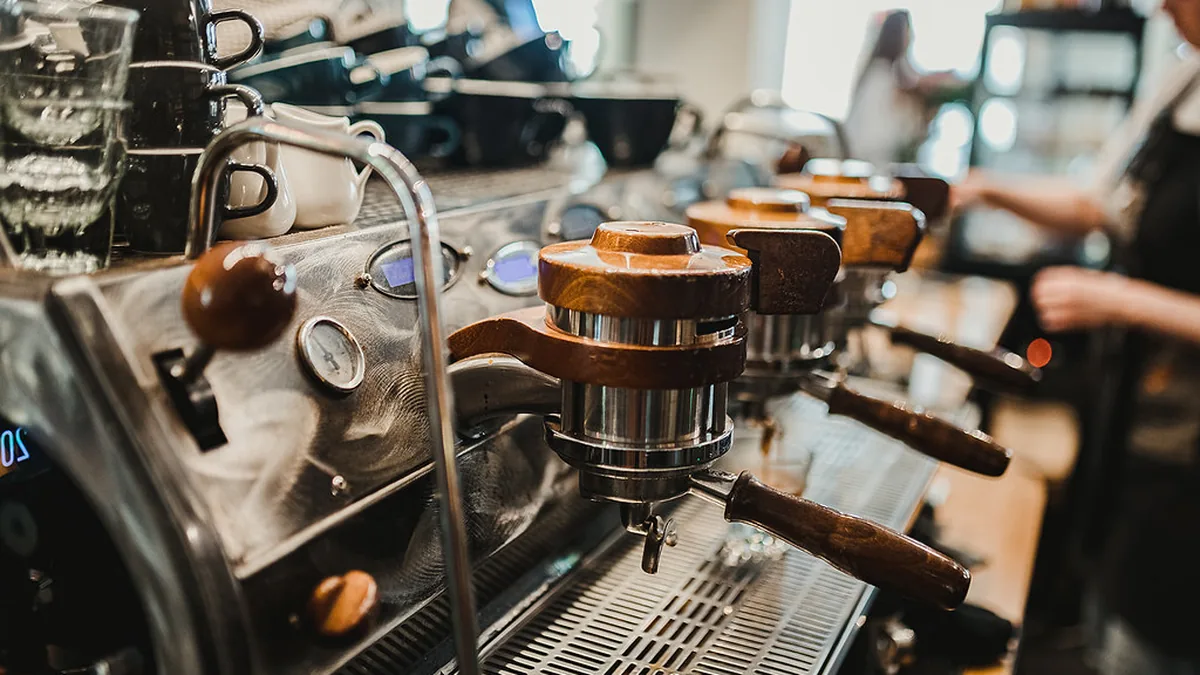
An espresso machine is one of the few kitchen appliances where the type you choose decides how much of the work you do every morning. Some machines leave every step to you; others grind, dose, tamp and froth at the touch of a button. This guide explains the main types, what actually affects the coffee in the cup, how much maintenance each one needs, and when a cheaper setup will do.
What "espresso" means
The Specialty Coffee Association's long-standing reference definition describes espresso as a 25 to 35 ml drink made from 7 to 9 grams of coffee, with clean water at 195 to 205°F (about 90.5 to 96°C) forced through it at 9 to 10 atmospheres of pressure, over 20 to 30 seconds. The SCA itself has pointed out that baristas now work well outside those numbers: in a survey it reported, the typical modern shot used an 18 to 20 gram dose, a roughly 1:2 ratio of coffee to liquid espresso, 9 bar of pressure and around 200°F. The point for buyers is that espresso is defined by finely ground coffee, hot water and real pressure. A machine needs to deliver stable temperature and pressure, and you need a way to grind fine and consistently.
The main types
Manual (lever) machines
On a lever machine you create the pressure yourself by pulling a lever. They are mechanically simple, quiet and often very durable, but they have the steepest learning curve and leave everything, including timing and pressure, in your hands. They suit people who enjoy the process as much as the drink.
Semi-automatic machines
This is the classic home espresso machine: a pump provides the pressure, you start and stop the shot, and you grind, dose and tamp the coffee into a portafilter yourself. Many add a steam wand for milk. Some include a built-in grinder; others need a separate one. Semi-automatics give you control over every variable and are the usual choice for people who want café-style drinks and are willing to learn. Expect some practice before your shots are consistent.
Automatic and bean-to-cup machines
Bean-to-cup (sometimes called super-automatic) machines grind the beans, dose, tamp, brew and in many cases froth milk automatically. You fill the hopper and water tank and press a button. They are the most convenient option and suit households where several people want different drinks quickly. The trade-off is less control over each shot, more internal parts, and a stricter cleaning routine set by the manufacturer.
Capsule and steam machines
Capsule machines are not covered in detail here, but they are the simplest route to an espresso-style drink. Low-cost "steam" espresso makers that use boiler pressure rather than a pump cannot reach the pressures in the definition above. They have also been the subject of safety recalls: the US Consumer Product Safety Commission recalled about 12,300 Sensio steam espresso makers sold under the Bella Pro Series and Cooks names after reports that the brew cup handle could eject forcefully, with burn and laceration injuries reported. Whatever you buy, check the CPSC's recall list for the model.
What actually matters for the coffee
- The grinder. Espresso needs a fine, even grind that you can adjust in small steps. Breville's own troubleshooting advice is to grind finer if the shot runs too fast, and to use a coarser grind or a slightly smaller dose if it runs too slowly. That only works if the grinder can make those small changes. If you buy a semi-automatic without a built-in grinder, budget for a capable burr grinder; it often matters more than extra features on the machine.
- Fresh beans. Breville notes that ground coffee starts losing aroma within minutes of grinding. Whole beans ground just before brewing give better results than pre-ground coffee.
- Temperature stability. Look for how the machine heats water and how quickly it recovers between shots, especially if you make several drinks in a row or steam milk straight after brewing.
- Milk. If you mostly drink lattes and cappuccinos, the steam wand or automatic milk system matters as much as the espresso. A manual wand gives better texture with practice; an automatic system is easier but needs daily cleaning.
- Water. Water is most of what is in the cup. Breville recommends filtered water with a moderate, but not too high, mineral content, both for flavour and to limit scale.
Maintenance and descaling
Every espresso machine heats water, and hard water leaves mineral scale in boilers, pipes and pumps. Manufacturers are consistent that descaling is not optional, but their schedules differ, so follow the manual for your model.
- How often. Breville's advice is to descale every one to three months depending on use, and its machines show an alert when a descale is due. De'Longhi's general guidance for its pump espresso machines is to descale after 200 uses, with the frequency depending on your water hardness; some De'Longhi models can be programmed for your water hardness so the descale light comes on at the right interval. Many machines ship with a test strip for exactly this purpose.
- What to use. Use the descaler your manufacturer specifies. De'Longhi says, for its Magnifica Evo bean-to-cup machines, that using an unsuitable descaler, or descaling incorrectly, may cause faults not covered by the guarantee. JURA likewise tells owners to use its own descaling and cleaning tablets, which it says are formulated for its machines' programmes and materials.
- Water filters. Many machines take a filter cartridge in the water tank, which reduces scale. On some JURA models, the manuals say the machine no longer needs descaling while a compatible filter cartridge is in use, as long as it is changed on schedule.
- Daily and weekly cleaning. On a semi-automatic, clean the portafilter, basket and group head after use, and wipe and purge the steam wand after every milk drink. Bean-to-cup machines run their own rinse and cleaning cycles, use cleaning tablets, and in many models need the milk system cleaned daily.
- Signs it is overdue. Breville lists low or inconsistent pressure and lukewarm shots among the symptoms of scale build-up. If descaling does not fix them, contact the manufacturer's support before taking anything apart.
Factor the running costs into your budget: descaler, cleaning tablets, filter cartridges and milk system cleaner are ongoing purchases, especially for bean-to-cup machines.
How to choose
- Decide how hands-on you want to be. If you enjoy the process and want control, a semi-automatic with a good grinder is the usual choice. If you want one-touch drinks for a busy household, look at bean-to-cup.
- Count the drinks. Mostly espresso, or mostly milk drinks? How many people, how many cups in a row?
- Check the grinder situation. Built in, or a separate purchase? Can it adjust finely?
- Read the maintenance section of the manual before you buy. Manufacturers publish their manuals online. The cleaning routine is a good preview of daily life with the machine.
- Look at warranty and support. Check the warranty length, what voids it (such as using the wrong descaler), and whether parts and service are available where you live.
- Measure your counter. Note height under cabinets and the space needed to refill the water tank and bean hopper.
When cheaper is enough
If you drink one milk-based coffee a day and are not chasing café-quality espresso, a simple pump machine or a capsule machine may be all you need, and a moka pot or other stovetop brewer makes strong coffee for very little money, although it is not espresso by the definition above. Spending more makes the most sense when you know you will use the extra control or convenience every day.
The bottom line
Choose the type by how much of the process you want to do yourself, give the grinder and water as much attention as the machine, and budget time and money for descaling and cleaning. A well-maintained mid-range machine will make better coffee for longer than an expensive one that is never descaled.