OP-XY review: what teenage engineering's sequencer does well, and where reviewers found limits
A research-based review of the OP-XY: the specifications teenage engineering lists, what MusicRadar, Sound On Sound and others praised and criticised, and what firmware has changed since.
This review is based on teenage engineering's own documentation and the published findings of reviewers who used the OP-XY; NerdBible has not tested it. Every specification below comes from teenage engineering's product page, guide or release notes, and every opinion is attributed to the outlet that expressed it.
Reviewers broadly agree on three things: the OP-XY's sequencer is exceptional, the hardware is beautifully built, and it is very expensive. Where they split is on whether the price is justified. Sound On Sound called it "a genuinely useful and accessible portable workstation" and suggested it may be the most functional dedicated device of its size; MusicRadar concluded that it "costs too much", while admitting its reviewers still wanted one. Several of the early complaints, notably the lack of sample slicing, have since been addressed in firmware.
What the OP-XY is
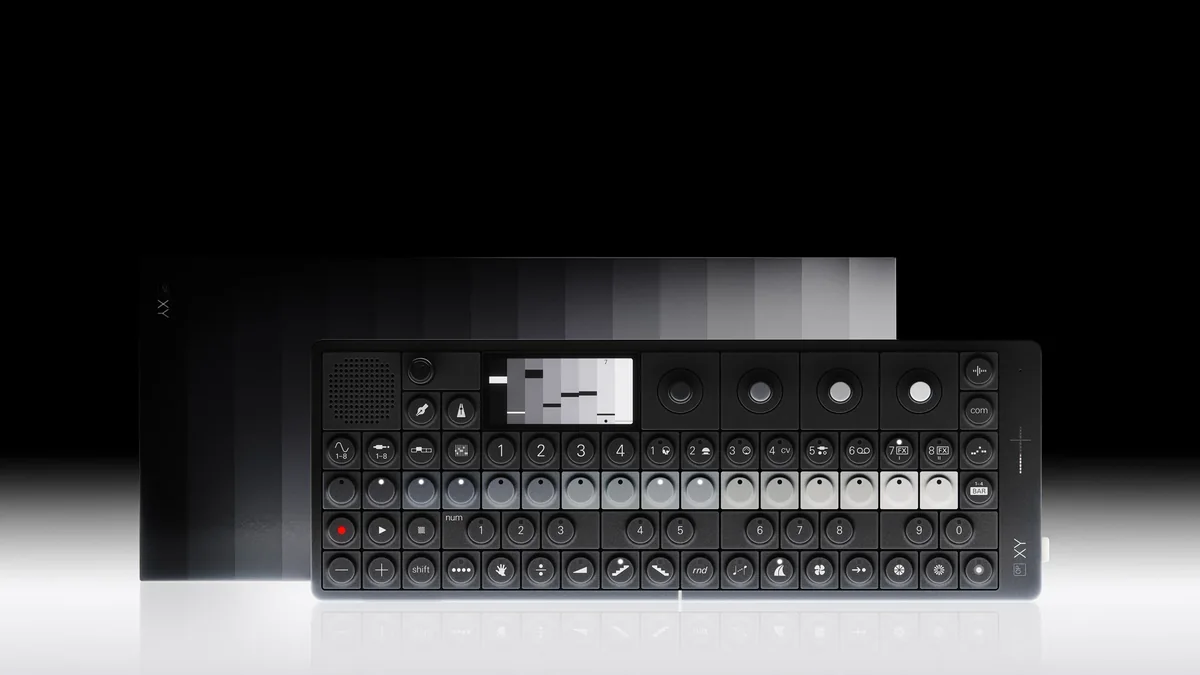
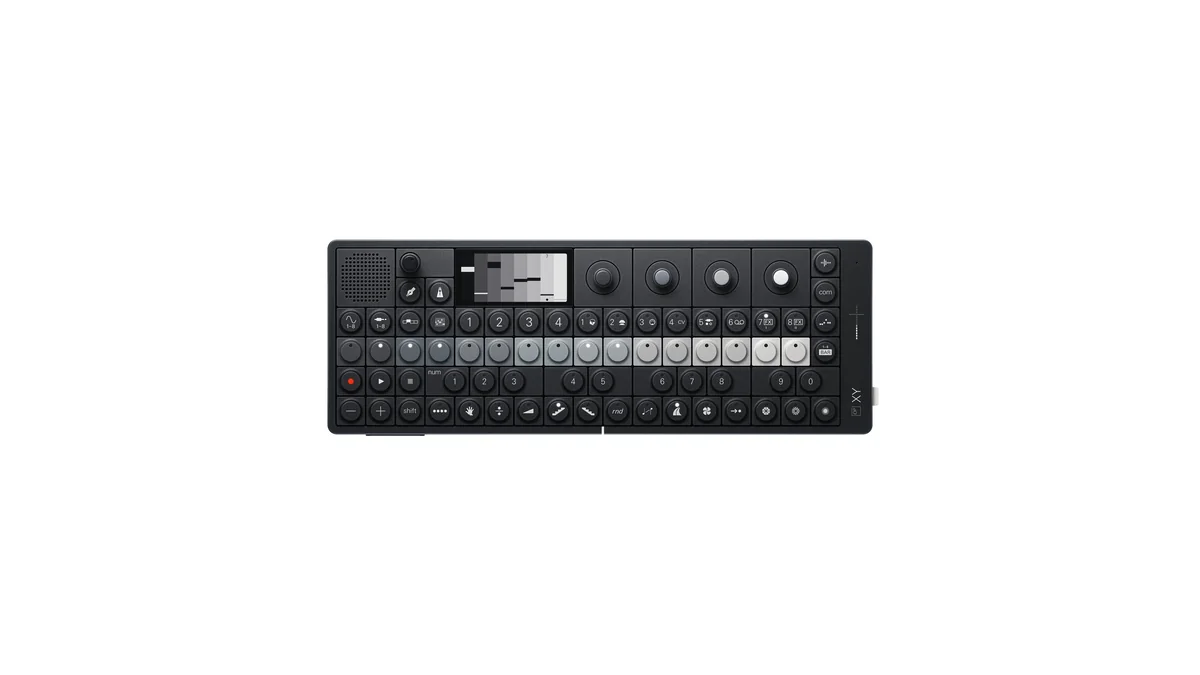
The OP-XY is a portable sequencer, synthesizer and sampler. In practice it combines the step-sequencing workflow of teenage engineering's earlier OP-Z with the body and layout of the OP-1 field, adding a screen the OP-Z never had. CDM described it at launch as "a more mature OP-Z follow-up with a rich complement of sequencing features", and Orb Mag as a fusion of "the powerful sequencer of the OP-Z with the robust industrial design, high-fidelity DSP, and general layout of the OP-1 field". It runs on an internal battery, has a built-in speaker and microphone, and is meant to be both a self-contained studio and the brain of a larger setup.
Sequencer: 64 steps per pattern across 4 pages, 14 step components that can all be applied to every step, 10 grooves, independent track lengths and speeds, microtonal tuning. The product page lists 9 patterns per track and 99 scenes; release notes for firmware 1.1.15 raised patterns per track to 16.
Controls: a two-octave keyboard, 68 low-profile mechanical buttons, pressure-sensitive pitch bend, four multi-purpose encoders, a 6-axis motion sensor.
Screen: 480 x 222 pixel IPS TFT display.
Effects: reverb, delay, chorus, distortion, lo-fi and phaser.
Connectivity: USB-C (MIDI and audio, host and device), Bluetooth LE MIDI, 3.5 mm stereo line out with headset microphone support, 3.5 mm multi-out (CV, MIDI, sync or audio), 3.5 mm MIDI in, 3.5 mm stereo line in.
Hardware: dual Blackfin processing cores, a triple-core DSP and separate controllers for wireless and low-power functions.
Battery: 16 hours, according to teenage engineering. magazin Mehatronika said that figure "roughly checks out" in its use. The OP-XY user guide advises charging at least every six months to keep the battery healthy.
The product page does not state size or weight. Gearnews gave the dimensions as 288 x 102 x 30 mm. Firmware 1.0.25 raised the maximum loaded sample memory to 64 MB, according to the release notes.
Price: teenage engineering's store shows the price for your region and runs promotions, so no single figure applies everywhere. At launch, MusicRadar and Sound On Sound listed it at £1,899 and $2,299, with MusicRadar adding €2,299. Retailer prices have varied since, so check the official store for your country.
What reviewers liked
The sequencer. Sound On Sound singled out the step component system, which modifies individual steps with repeats, ratchets, pitch ramps, jumps and conditional skips, as "what's really exciting" about the OP-XY, and listed "fantastic sequencing with step components and performance effects" first among its pros. Orb Mag called step components "a cornerstone of the OP-XY's sequencing power".
Brain and punch-in effects. Sound On Sound said these "generate interesting tracks from simple starting points"; Orb Mag described the brain track as "an excellent tool for coming up with unexpected melodic ideas and chord changes".
Build and design. MusicRadar found it "as logical to use as any OP" and as well built. Mehatronika praised the screen and said the larger, more tactile buttons make it "feel like a real instrument" compared with the OP-Z.
Ease of getting started. MusicRadar said it "can go deep but still relatively easy to use". Gearnews, which took it into the studio and on the road, called the experience "a complete success" despite the high price.
Connectivity. Orb Mag highlighted the multi-mode output for MIDI and CV as making it easy to integrate into a larger setup, and CDM noted it has jacks for audio, MIDI, sync and CV as well as USB-C.
What reviewers criticised
Price. The most consistent complaint. MusicRadar listed "price makes it rather elitist" among its cons; CDM called it "a real luxury item"; MusicTech published a guide to what else $2,300 could buy and urged readers not to make it their first piece of music gear.
A closed workflow. Sound On Sound listed "no export or multi-channel output" as a con: at the time of its review there was no way to bounce stems and no multi-channel USB audio. We did not find stem export in the release notes through version 1.1.33.
The multi-out does one thing at a time. Sound On Sound was disappointed that the multi-purpose port can carry CV, MIDI or audio, but only one of them at once, and that the brain does not affect the auxiliary MIDI and CV tracks.
Sampler limits at launch. Sound On Sound and Orb Mag both noted there was no way to chop samples on the device, and Sound On Sound found that all sounds in the drum sampler share one envelope and filter setting. Slicing has since been added (see below).
Stepped controls. Sound On Sound found that the clicky encoders make synth tweaking "inherently steppy", and that changing filter mode resets its parameters.
Bugs at launch. Orb Mag said "a few bugs" were still being worked out, and Mehatronika's review flagged "some missing features and bugs still present".
Firmware updates and what they changed
teenage engineering publishes OP-XY updates with release notes on its downloads page; updates are free and can be installed from a web browser or by copying a file in the TE boot mode. Highlights, by version:
1.0.13: sample loading up to 30% faster, pitch bend tuning, press and hold to copy a step.
1.0.21: crash and freeze fixes, file moving over USB (MTP). The notes flagged a known issue that could corrupt data when user data exceeded 4 GB.
1.0.25: stability fixes and maximum loaded sample memory raised to 64 MB.
1.0.29: MIDI clock over Bluetooth, up to 96 scenes per song, arranger improvements. This version was later withdrawn: the 1.0.32 notes warn that it could corrupt files larger than 64 KB copied off the device over MTP, and recommend updating.
1.0.38: count-in before recording and faster boot.
1.1.0: a sample slice mode, a "duck" LFO for sidechain-style effects, sound link across patterns, delayed scene switching and parameter locks on the drum and synth samplers. Gearnews described slicing by transient, by time or manually.
1.1.15: patterns per track increased from 9 to 16, project templates, rotate trigs, a MIDI monitor, on-screen voice, CPU and sample memory indicators, improved voice limiting to reduce pops and crackles, and a proper sustain pedal mode.
1.1.25 to 1.1.33: quantisation for odd track scales, multisample and transpose improvements, and a long list of sequencer and stability fixes.
The pattern of updates matters for buyers: several reviewers' complaints were addressed after their reviews were written, so older reviews understate what the current firmware does. Equally, the corruption warnings in early versions are a reason to keep the device updated and back up projects.
How it compares
OP-XY vs OP-1 field
The OP-1 field shares the body but works differently. It records synths and samples onto tape tracks, with eight swappable tapes, and lists a 24-hour battery against the OP-XY's 16. Sound On Sound wrote that, unless a linear recording workflow appeals, the OP-XY is "way more accessible and productive for creating songs and performances than the OP-1", because the OP-1 can only capture ideas by recording them to tape. MusicRadar also judged the OP-1 field's price its main drawback.
OP-XY vs EP-133 K.O. II
The EP-133 K.O. II is teenage engineering's sampler and beat machine: 999 sample slots, 12 tracks per pattern, punch-in effects, four AAA batteries or USB-C, and a US price on its product page of $329. MusicRadar called it "far from the most powerful sampler on the market" but great fun within its limits. For sample-based beat making on a budget it covers much of the same ground; the OP-XY adds synth engines, a far deeper sequencer, CV and a screen.
Non-teenage engineering alternatives
Elektron Digitakt II: a 16-track drum computer and stereo sampler with a 128-step sequencer, built for the desk rather than the pocket. MusicTech listed it among things to consider instead.
Polyend Tracker Mini: a compact tracker-style sequencer with sampling, a 16-track sequencer and synth engines added in firmware 2.0, according to Polyend.
Roland SP-404MKII: a performance sampler with 17 pads, 16 GB of storage and the option of six AA batteries, weighing 1.1 kg according to Roland. It is a sampler first, with far less sequencing depth than the OP-XY.
Who should buy it, and who should skip it
Consider it if you want a single portable device for writing and performing sequenced music, you already know you like teenage engineering's approach, you value step components and generative tools over linear recording, or you want a sequencer that can also drive external synths and modular gear over MIDI and CV.
Skip it if this would be your first music hardware, you need to export stems or multitrack audio to a computer, you mainly chop and arrange samples (a dedicated sampler costs a fraction as much), or the price would stop you buying anything else for a long time. MusicTech's advice on first purchases is blunt on that point.
Pros and cons
Pros (as reported by reviewers and listed by the maker)
Deep, flexible sequencer with 14 step components, brain and punch-in effects
Eight synth engines and three samplers in one portable unit
Built-in speaker, microphone and a 16-hour battery by the maker's figure
MIDI, CV, sync and audio connectivity plus Bluetooth MIDI
Regular free firmware updates that have added significant features
Cons (as reported by reviewers)
Very high price for a portable groovebox
No stem export or multi-channel USB output at review
Multi-out carries only one signal type at a time
Stepped encoders and some workflow quirks
Early firmware had bugs, including file corruption issues later fixed