
If you are in crisis in the US, call or text 988 to reach the 988 Suicide & Crisis Lifeline, which says it is free, confidential and available around the clock. If someone is in immediate danger, call 911. BetterHelp is not an emergency service: its homepage tells visitors that if they are in a crisis or any other person may be in danger, they should not use the site.
This BetterHelp review is an editorial assessment built from BetterHelp's own pages, the Federal Trade Commission's public record, guidance from public health bodies and the published findings of independent reviewers. NerdBible did not sign up for therapy to write it. Nothing here is medical advice: whether online therapy suits you, and which kind of professional you need, is a question for a qualified clinician.
Our verdict: is BetterHelp worth it?
BetterHelp is the online therapy service we rank first for most adults who want regular talk therapy without travelling to an office. Its main strengths are scale and flexibility. The homepage counts more than 31,000 licensed therapists, members can talk to their therapist by message, live chat, phone or video, and switching to a different therapist is a self-service step rather than an awkward conversation. For someone who has never tried therapy, or who has struggled to find a local provider with open slots, that combination removes a lot of friction.
It is not the right tool for everyone. BetterHelp's therapists do not prescribe medication, and the FAQ says they will not make an official diagnosis. It is not built for crisis care, it does not meet court orders, and it is for adults. Its privacy history also matters: the FTC took action against the company over sharing health-related data for advertising, a point we cover in detail below. Our overall view is that BetterHelp is a strong, convenient default for non-urgent talk therapy, provided you go in knowing those limits.
What is BetterHelp and who is it for?
BetterHelp is a subscription platform that connects adults with licensed mental health professionals online. Its About page says it is part of Teladoc Health and describes its mission as removing traditional barriers to therapy. The company also runs separate services for couples (Regain) and for teenagers aged 13 to 19 (Teen Counseling), according to its online therapy page; BetterHelp itself is for adults.
The online therapy page lists the kinds of concerns its therapists work with, including anxiety, depression, stress, grief, trauma and relationship issues. The service tends to suit people who:
- want ongoing, non-urgent talk therapy at home;
- value being able to message a therapist between sessions;
- live somewhere with few local therapists or long waiting lists;
- want to choose between video, phone and text based contact.
The National Institute of Mental Health describes psychotherapy as a set of treatments that help people identify and change troubling emotions, thoughts and behaviours, and it notes that digital platforms have opened up access where professionals may not be physically available. NIMH also stresses that rapport and trust with a therapist are essential, which is one reason BetterHelp's easy switching matters.
Key features of BetterHelp
A large network of licensed therapists
The homepage shows a live counter of licensed therapists, above 31,000 when we checked, and the FAQ lists the credentials it accepts: licensed psychologists (PhD or PsyD), licensed marriage and family therapists, licensed clinical social workers, licensed professional counsellors and licensed mental health counsellors. BetterHelp says each therapist has at least three years of experience and at least 1,000 hours of hands-on practice.
Four ways to talk
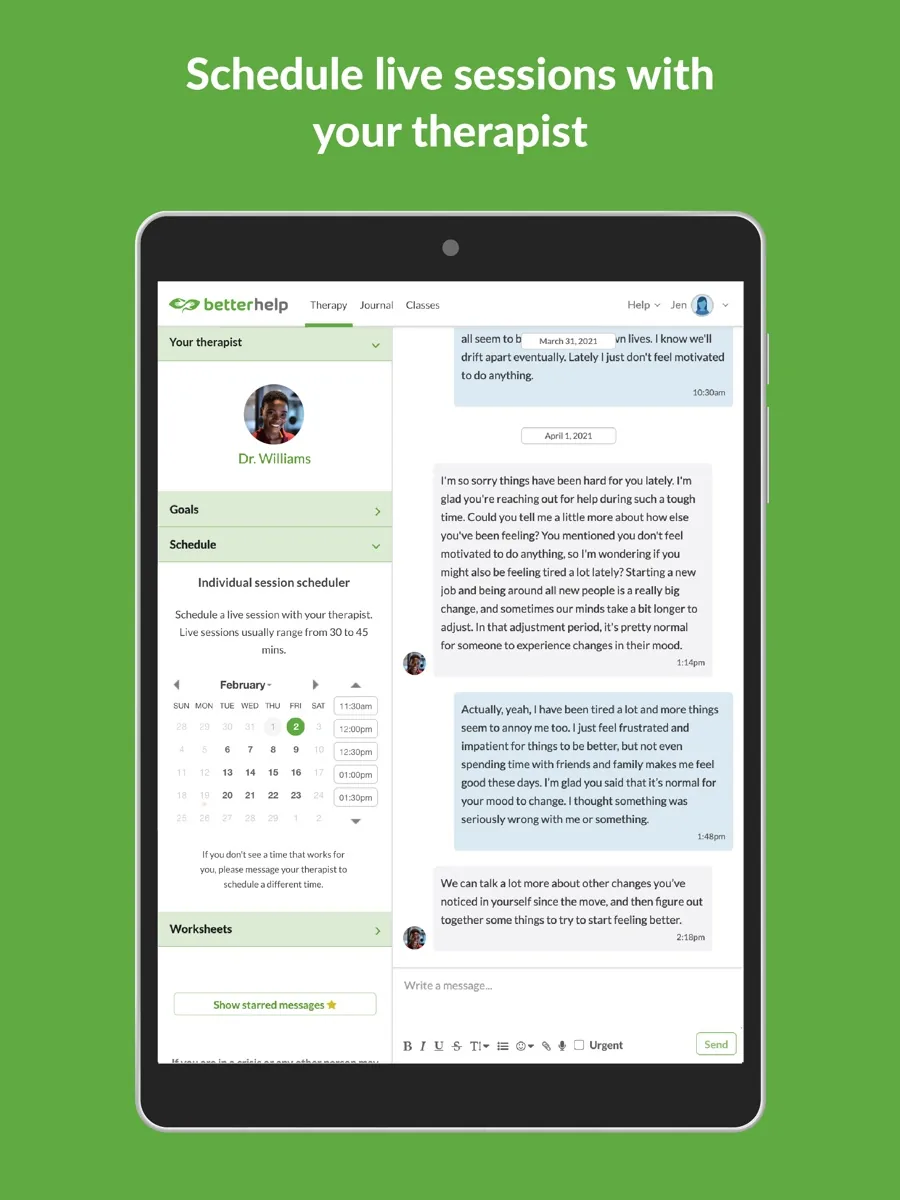
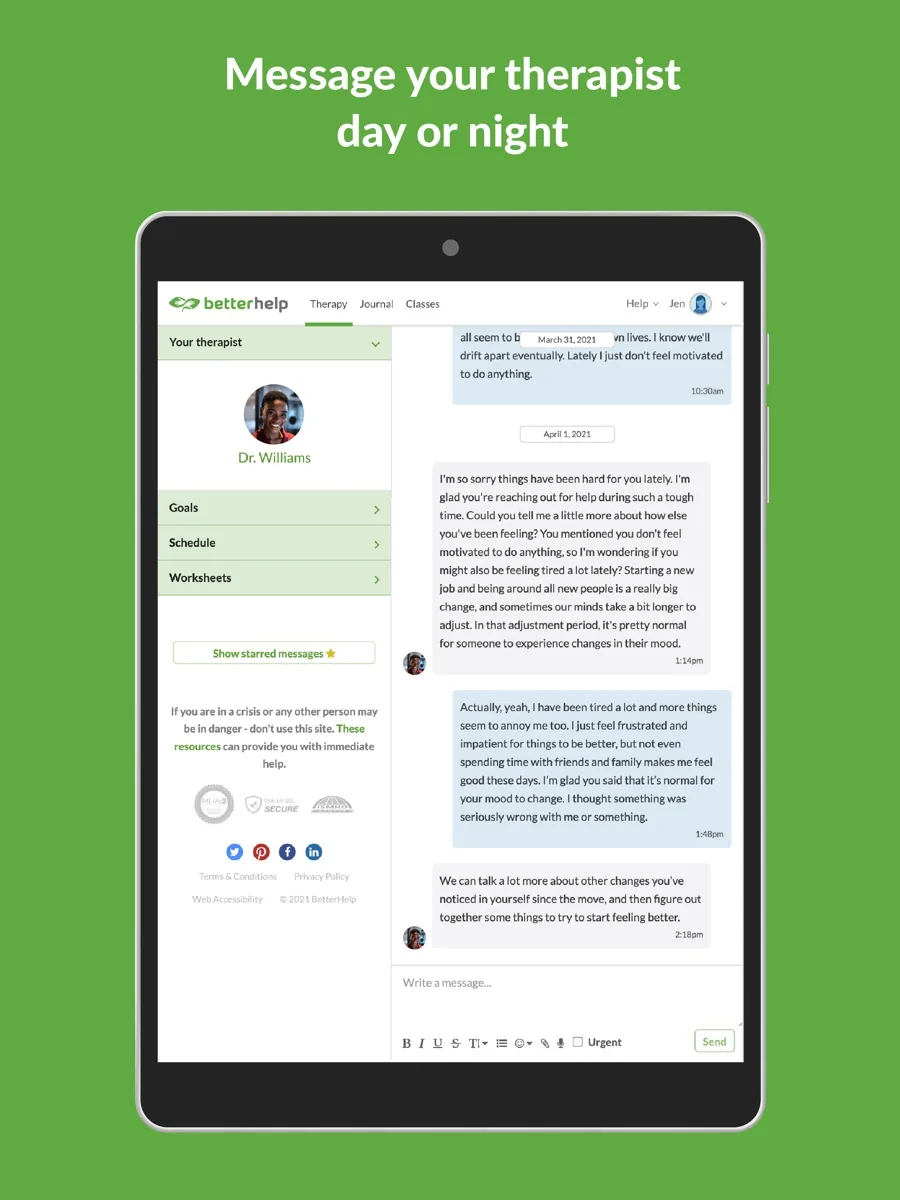
The FAQ names four formats: exchanging messages, chatting live, speaking over the phone and video conferencing. The online therapy page says members can message their therapist at any time between sessions, and that the subscription includes a weekly live session that typically lasts 30 to 45 minutes. Therapists reply to messages when they are available, so messaging is asynchronous rather than instant.
Questionnaire based matching
New members answer an intake questionnaire about their needs and preferences, and the homepage says BetterHelp then matches them with a provider based on those needs, preferences and demographics. The insurance page says members can go from sign-up to a first session in as little as two days.
Switching therapists
If the fit is wrong, the homepage says you can click a button and be matched with another provider, and the online therapy page says switching carries no extra cost. Given how much NIMH emphasises rapport, this is one of the most useful features on the platform.
Extras between sessions
Independent reviewers describe journaling tools, worksheets and group sessions alongside one to one therapy. HelpGuide and Choosing Therapy both mention these extras.
How much does BetterHelp cost? Plans and pricing structure
We do not quote prices in reviews because they change and vary by person; our product card shows our current figures. What we can describe is the structure. BetterHelp is a recurring membership, not a pay per session service. The online therapy page says members can be billed weekly or monthly, and the FAQ says the cost depends on your location, how you found BetterHelp, your preferences and therapist availability, so two people can see different figures. The FAQ lists credit and debit cards, PayPal, Apple Pay and Google Pay, and says you can cancel your membership at any time, for any reason.
Insurance. This has changed. BetterHelp's insurance page now says it is in network with more than 125 health plans, naming insurers such as Aetna, Anthem, Blue Cross Blue Shield, Cigna and UnitedHealthcare, with coverage that varies by state and plan. The same page states that insured members get one covered live session per week and that some features, including chat based sessions, groups and some self-help tools, may be limited or unavailable when using insurance. Several reviewers, including Healthline and Choosing Therapy, report that Medicare and Medicaid are not accepted. Check your own plan before relying on coverage.
Financial aid. The online therapy page says financial assistance may be available in some cases, depending on income or employment status. The About page adds that BetterHelp funds free therapy through partnerships with more than 100 nonprofit organisations.
Is BetterHelp safe? Privacy, security and the FTC order
Any review of BetterHelp has to cover this. The Federal Trade Commission announced an order banning BetterHelp from sharing consumers' health data, including sensitive information about mental health challenges, for advertising. The FTC alleged that, despite promising to keep such information private, the company used and revealed consumers' email addresses, IP addresses and health questionnaire information to Facebook, Snapchat, Criteo and Pinterest for advertising. The order also requires BetterHelp to obtain affirmative express consent before disclosing personal information to certain third parties and to put stronger data safeguards in place.
BetterHelp agreed to pay millions of dollars to settle the charges. The FTC's refunds page says the money was sent back in two rounds to eligible customers who signed up and paid during the period the complaint covered, across BetterHelp and sister brands such as Regain, Teen Counseling, Faith Counseling and Pride Counseling.
BetterHelp's current privacy policy says it does not share any information members share with their therapist with third party advertisers, that messages are protected with 256-bit encryption, and that advertising cookies, if a visitor accepts them, exclude activity once a member is logged in and has started therapy. It also says members can request deletion of their account, while clinical records are kept for a period set by law. Insured members are covered by a separate Notice of Privacy Practices. These are meaningful commitments backed by an FTC order; if you are uneasy about any marketing use of your visit, decline advertising cookies.
On confidentiality, the FAQ explains that therapists follow state mandated reporting rules, which means there are limited situations, such as a risk to someone's safety, where they may have to share information.
What could be better
- No medication or diagnosis. The FAQ is explicit that providers will not prescribe medication or make an official diagnosis. People who may need psychiatric care need a different service alongside or instead.
- Not for emergencies. BetterHelp says not to use the site in a crisis. The 988 Lifeline exists for that.
- Insurance comes with trade-offs. Insured members get one covered live session a week and may lose access to chat sessions and some extras, per the insurance page.
- Price varies and is not shown up front. Because cost depends on location and preferences, you only see your figure after the questionnaire.
- Customer support. HelpGuide's user survey and Choosing Therapy both flag support as a weaker area.
- Privacy history. The FTC order addresses past conduct, but trust is a fair concern for a service that handles mental health information.
Who should choose something else?
BetterHelp is a poor fit if you:
- are in crisis or at risk of harm: call or text 988, or call 911 in an emergency;
- need medication management, a formal diagnosis or documentation for work, school or disability purposes;
- need therapy to satisfy a court order, which the FAQ says BetterHelp cannot meet;
- are under 18, in which case Teen Counseling or a local provider with parental involvement is the route;
- rely on Medicare or Medicaid, or have an insurer BetterHelp is not in network with in your state;
- prefer in-person care, or lack a private space and stable internet connection for sessions.
Low cost options also exist. Many employers offer an employee assistance programme with a number of free counselling sessions, and community clinics often charge on a sliding scale. A doctor or a qualified mental health professional can help you work out which kind of care fits your situation.
What other reviewers found in their BetterHelp reviews
- Healthline had two people use the service for several months; its testers were matched quickly and liked being able to switch providers, but one felt her therapist was at times not fully engaged, and the review notes a cap on how many sessions can be booked ahead.
- HelpGuide placed BetterHelp joint first among online therapy platforms and recommends it for people without insurance; its user survey found high overall satisfaction but a meaningful share of users reporting app crashes and slow customer support replies.
- Choosing Therapy gave it four out of five, praising fast access and the extras between sessions, while criticising patchy insurance coverage, the lack of superbills for out of network claims and weaker customer service.
- Psych Central found scheduling flexible and the therapists professional, and reminded readers that there are no psychiatrists on the platform and that it is not designed for crisis care.
- Medical News Today liked the fast matching and the range of contact methods, but its testers found some therapists had not read their intake answers and that managing or cancelling a subscription was less transparent than it should be.
Where they agree. Every outlet credits BetterHelp with quick matching, flexible formats and easy switching, and every one notes the absence of prescribing and diagnosis and the FTC privacy case. Where they differ. Opinions split on value and on the day to day experience: HelpGuide's survey and Choosing Therapy rate support and value less highly than therapist quality, while Psych Central's testers came away more uniformly positive. Medical News Today and Healthline flag friction in account management and scheduling that others do not mention.
What that means for you. The reviewers broadly agree on what BetterHelp does well, and the disagreements are about individual fit and admin rather than core safety. Treat the first few sessions as a trial, switch therapists early if the match feels wrong, and read the billing and cancellation settings in your account before you need them.
Bottom line
BetterHelp earns its place at the top of our online therapy ranking through the size of its licensed network, the choice of message, chat, phone and video contact, and genuinely easy therapist switching, with financial aid and growing insurance coverage for some members. Its limits are just as clear: no prescribing, no diagnosis, no crisis care, adults only, and a privacy record that led to an FTC order. If you need ongoing, non-urgent talk therapy and those limits do not affect you, it is a sensible place to start. If you are unsure what kind of care you need, speak to a doctor or another qualified professional first, and if you are in crisis in the US, call or text 988.
Frequently asked questions
Is BetterHelp legit?
Yes. BetterHelp is part of Teladoc Health, and its FAQ says every provider is a licensed psychologist, marriage and family therapist, clinical social worker, professional counsellor or mental health counsellor with at least three years of experience. It has also faced an FTC order over past sharing of health data for advertising, so legitimacy and a spotless record are not the same thing. Review the privacy policy and decide what you are comfortable with.
Does BetterHelp take insurance?
In some cases. BetterHelp's insurance page says it is in network with more than 125 health plans, with coverage varying by state, insurer and plan. Insured members get one covered live session a week, and chat sessions, groups and some self-help tools may be limited. Independent reviewers report that Medicare and Medicaid are not accepted. Check your own plan's details during sign-up rather than assuming you are covered.
Is messaging with a BetterHelp therapist unlimited?
BetterHelp's online therapy page says subscribers can message their therapist anytime between sessions, and reviewers such as HelpGuide describe this as unlimited messaging. Therapists reply when they are available, so it is not a live, on demand service. The weekly live session usually lasts 30 to 45 minutes. Insured members may find some chat features limited, according to BetterHelp's insurance page.
Can a BetterHelp therapist prescribe medication or diagnose me?
No. BetterHelp's FAQ states that providers will not make any official diagnosis and will not prescribe medication. If you think you may need medication or a formal diagnosis, speak to a doctor or psychiatrist. Some people combine talk therapy on a platform like BetterHelp with separate psychiatric care, but that is a decision to make with a qualified professional who knows your history.
What should I do in a mental health emergency?
Do not wait for a therapist's message reply. In the US, call or text 988 to reach the 988 Suicide & Crisis Lifeline, which is free, confidential and available every hour of every day, or use its online chat. If anyone is in immediate danger, call 911. BetterHelp itself says its site should not be used if you are in a crisis or someone may be in danger.
Can I cancel BetterHelp at any time?
BetterHelp's FAQ says you can cancel your membership at any time, for any reason. Because billing is a recurring subscription, cancel before your next billing date if you do not want to be charged again. Medical News Today's reviewers found the cancellation process less clear than they expected, so check the billing section of your account settings and keep confirmation of the cancellation.
Sources
- BetterHelp homepage, BetterHelp
- Frequently Asked Questions, BetterHelp
- Online Therapy Covered by Insurance, BetterHelp
- Online Therapy, BetterHelp
- Privacy Policy, BetterHelp
- About Us, BetterHelp
- FTC to Ban BetterHelp from Revealing Consumers' Data, Including Sensitive Mental Health Information, to Facebook and Others for Targeted Advertising, Federal Trade Commission
- BetterHelp Refunds, Federal Trade Commission
- 988 Suicide & Crisis Lifeline, SAMHSA
- Psychotherapies, National Institute of Mental Health
- BetterHelp Review, Healthline
- BetterHelp Review, Choosing Therapy
- The Best Online Therapy Platforms, HelpGuide
- BetterHelp Therapy Review, Psych Central
- BetterHelp Review: Is This Online Therapy Worth It?, Medical News Today