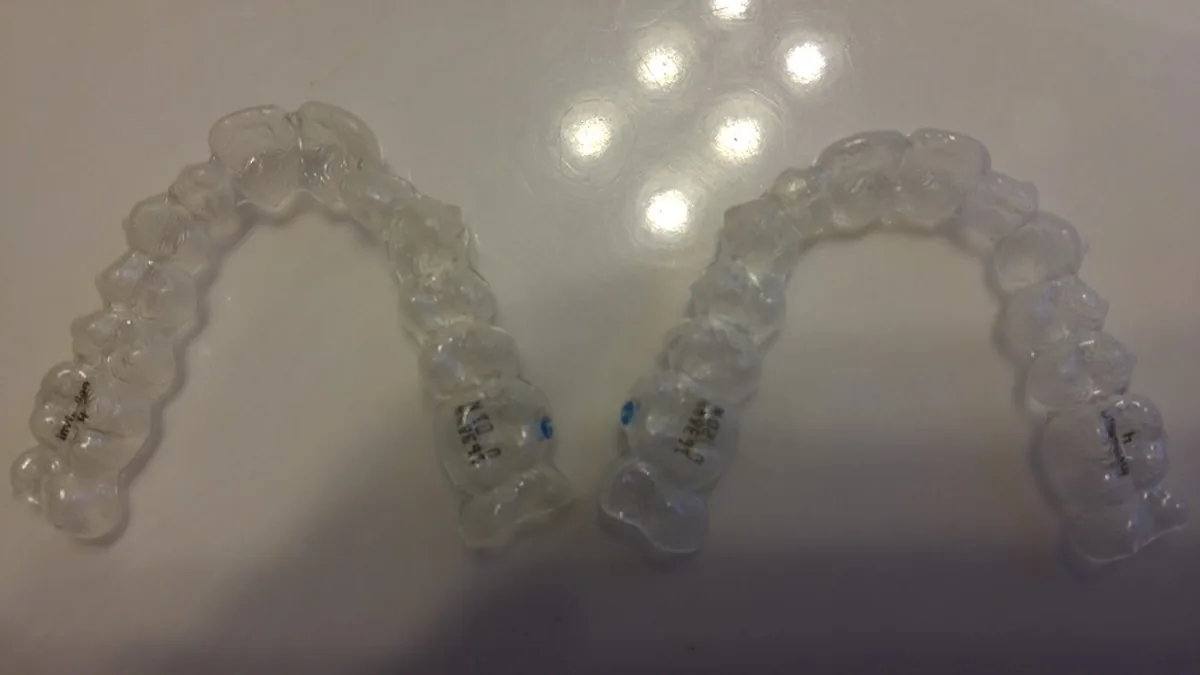
At-home clear aligners promised to cut out most of the trips to a dental office: you take impressions or a scan, a remote clinician plans the treatment, and trays arrive by post. That model depends on the company behind it. When the company stops trading, the support, the remaining trays and often the refund route can disappear together. Two of the best-known names in the category have shown how that plays out. This guide explains what happened to them, what to do if you are caught mid-treatment by a closure, and how to judge a provider's staying power before you sign up.
Two closures, two different endings
SmileDirectClub: a sudden stop
SmileDirectClub filed for Chapter 11 bankruptcy protection in the US Bankruptcy Court for the Southern District of Texas. In the press release it filed with the Securities and Exchange Commission, the company said it intended "to continue to provide affordable and accessible oral care to its customers without disruption" during the restructuring.
A few months later the company's website carried a very different message. Its customer FAQ, preserved by the Internet Archive, said SmileDirectClub had "made the incredibly difficult decision to wind down its global operations, effective immediately" and that "customer care support is no longer available." The same page said:
- orders that had not shipped were cancelled, and those customers "will not receive your aligners";
- customers who wanted to continue treatment should "consult your treating doctor or your local dentist";
- customers on the company's monthly payment plan were referred to the third-party financing company that serviced it for questions about what they still owed;
- the "Lifetime Smile Guarantee no longer exists";
- on refunds, "there will be more information to come once the bankruptcy process determines next steps."
The lesson is not that a bankruptcy filing always ends in closure. It is that a company's reassurance during restructuring is a statement of intent, not a guarantee.
Byte: a staged wind-down
Byte was owned by Dentsply Sirona, a large listed dental manufacturer. In a release filed with the SEC, Dentsply Sirona announced the voluntary suspension of sales and marketing of Byte aligners and impression kits "while the Company conducts a review of certain regulatory requirements," a decision it said was made in consultation with the Food and Drug Administration. It suspended shipment and processing of new and recently placed orders, and said it would keep "communicating with treating dentists and their patients to support their continued care as appropriate."
The company's most recent annual report says it later announced that Byte aligners would no longer be offered to new patients, that it had not accepted new Byte patients since the suspension, and that it continued to support "non-contraindicated Byte aligner patients currently undergoing treatment." The same report describes charges for customer refunds. Today byte.com carries a single line: "Byte has concluded its operations," with an email address, inquiries@byte.com, for questions.
So the two cases differ. One customer base lost support overnight; the other had a parent company that kept supporting some patients and set money aside for refunds. You cannot know in advance which kind of ending you will get, which is why the steps below are worth taking early.
If your aligner company shuts down: what to do first
1. Do not improvise with the trays you have
Aligners are prescription devices. The FDA's clear dental aligners page says they "are only safe to use under the supervision of a licensed practitioner, such as a dentist or orthodontist," and that in-person examination "can help lower the risks of uneven bite, unintended tooth movement, pain, and tooth loss." Whether to keep wearing your current set, move to the next one, or stop and hold your position is a clinical decision. Ask a dentist or orthodontist rather than guessing, and do not order replacement trays from an unknown seller to fill the gap.
2. Gather your records while you still can
If the company's website, app or patient portal is still working, download everything you can before it goes dark:
- your treatment plan and any 3D preview of the planned tooth movement;
- your scans or impression data, photos and check-in history;
- the name and licence details of the dentist or orthodontist who approved your treatment, if the company told you;
- your contract, consent forms, guarantee terms and any messages about your case;
- receipts, payment plan statements and card statements showing what you paid and when.
Write down which tray number you are on and when you started it. Keep your current and any unused trays, and the case they came in. A new clinician may not be able to use another company's plan directly, but the records show where you started and what was intended, and the paperwork is what any refund request or claim will rest on. If the company named a treating doctor, ask that doctor's office directly for copies of your records.
3. See a dentist or orthodontist
Book an in-person examination. The clinician can check how far your teeth have moved, whether anything has gone wrong, and what the realistic options are: finishing with a new plan, holding the current result with a retainer, or another approach. Be prepared for a new assessment and possibly new records, because a different provider will usually want to plan the rest of the treatment itself. The American Association of Orthodontists runs a directory of member orthodontists on aaoinfo.org.
If you have had pain, bite changes or other problems, the FDA's consumer update on braces and aligners says that you or your dentist can report a problem with an orthodontic device to MedWatch, the FDA's safety reporting programme.
4. Look at refunds and payments in general terms
What you can recover depends on how you paid, what your contract says and, if the company is in a bankruptcy or similar process, how that process handles customer claims. A few general points, which are not legal or financial advice:
- Watch for official notices. In a bankruptcy, the company or its claims agent usually publishes how customers can file a claim and by when. SmileDirectClub's filing, for example, pointed people to a claims agent's website. Missing a deadline can matter more than anything else.
- Card disputes have time limits. The Federal Trade Commission's guide to using credit cards and disputing charges explains the Fair Credit Billing Act, including the 60-day window for writing to your card issuer about a billing error and the conditions that apply to disputes over the quality of goods or services. The Consumer Financial Protection Bureau's page on how to dispute a credit card charge sets out the steps and advises keeping copies of all correspondence. Debit cards and financing plans follow different rules, so read your agreement.
- Do not simply stop paying a finance plan. SmileDirectClub's notice sent payment plan customers to the financing company, not to the closed business. Ask the lender in writing what you owe and what happens now.
For advice on your own situation, speak to a qualified professional or your state's consumer protection office.