
Our verdict
This Jackery review assesses the brand's range of portable power stations as a whole, using Jackery's own product and policy pages, the US Consumer Product Safety Commission's recall records and independent testing published by major outlets. NerdBible has not tested the units itself. On that evidence, Jackery is the brand we rank first for most buyers: its range runs from a small unit for charging phones and laptops to large home backup systems, it now uses long-life LiFePO4 batteries across the current lineup, and independent testers repeatedly pick its models for portability and real-world runtime.
It is not the cheapest brand per watt-hour, its smallest units lack conveniences such as a built-in light, and buyers who want to run a whole house for days will need one of its larger, heavier systems plus solar panels. Portable power stations are also large lithium batteries, so how you charge, store and use them matters for safety. Read the manual, follow the operating limits, and do not use one as a substitute for professional electrical work.
What it is and who it is for
A portable power station is a rechargeable battery with a built-in inverter and a mix of AC, USB and DC outlets. Jackery's power station range page describes them as quiet, fuel-free alternatives to a petrol generator that can be charged from a wall socket, a car or solar panels. Jackery groups its products into the Explorer series, which covers portable units for camping, travel and backup, and the HomePower series aimed more squarely at home backup.
Jackery units suit:
- Campers, van and RV travellers who want to run lights, fans, coolers and electronics without a noisy generator.
- Households preparing for power cuts who want to keep a fridge, router, lights or a home office running.
- Remote workers and creatives who need portable mains power away from an outlet.
- Anyone who wants a solar setup without a permanent installation.
Key features across the range
The lineup
From the specifications on Jackery's range page:
- Explorer 300: about 293 Wh of capacity, 300 W output and 7.1 lb, for phones, laptops, cameras and small devices.
- Explorer 1000 v2: a mid-size unit in the roughly 1 kWh class, widely reviewed (see below).
- HomePower 1000 Plus v2: 1,280 Wh and 1,800 W, described as modular from about 1 kWh up to 11 kWh with add-on batteries.
- Explorer 1500 Ultra: 1,536 Wh and 1,800 W, a rugged model.
- Explorer v2 at 2,042 Wh: 2,200 W output, 39.5 lb, aimed at home backup and longer trips.
- HomePower Plus v2 at 2,048 Wh: 2,400 W output, with Jackery quoting about 98 minutes to recharge from AC.
- HomePower 3600 Plus: 3,584 Wh and 3,600 W.
- Explorer 5000 Plus: 5,040 Wh and 7,200 W at over 130 lb, for whole-home and essential-circuit backup.
Every model listed on the range page uses a LiFePO4 (lithium iron phosphate) battery. Popular Mechanics notes that the Explorer 1000 v2's battery is rated for more than 4,000 charge cycles.
Charging options
All current units charge from a wall outlet, a car socket or compatible solar panels. Jackery's figures for AC charging range from about 1.5 to 3.5 hours depending on the model, with faster emergency charging modes on some units via its app. Jackery sells its own SolarSaga folding panels, which it says use monocrystalline cells with 23 to 25% efficiency; real-world output depends on sunlight, angle and temperature.
Safety and battery management
Jackery's battery management system, branded ChargeShield, is described on the range page as protecting against short circuits, voltage problems and temperature issues, with controlled charging and a temperature-aware design. Popular Mechanics also reports that the HomePower line includes a built-in uninterruptible power supply that switches over when the grid fails, and that the Explorer 1500 Ultra has an IP65 rating against dust and water jets.
App control
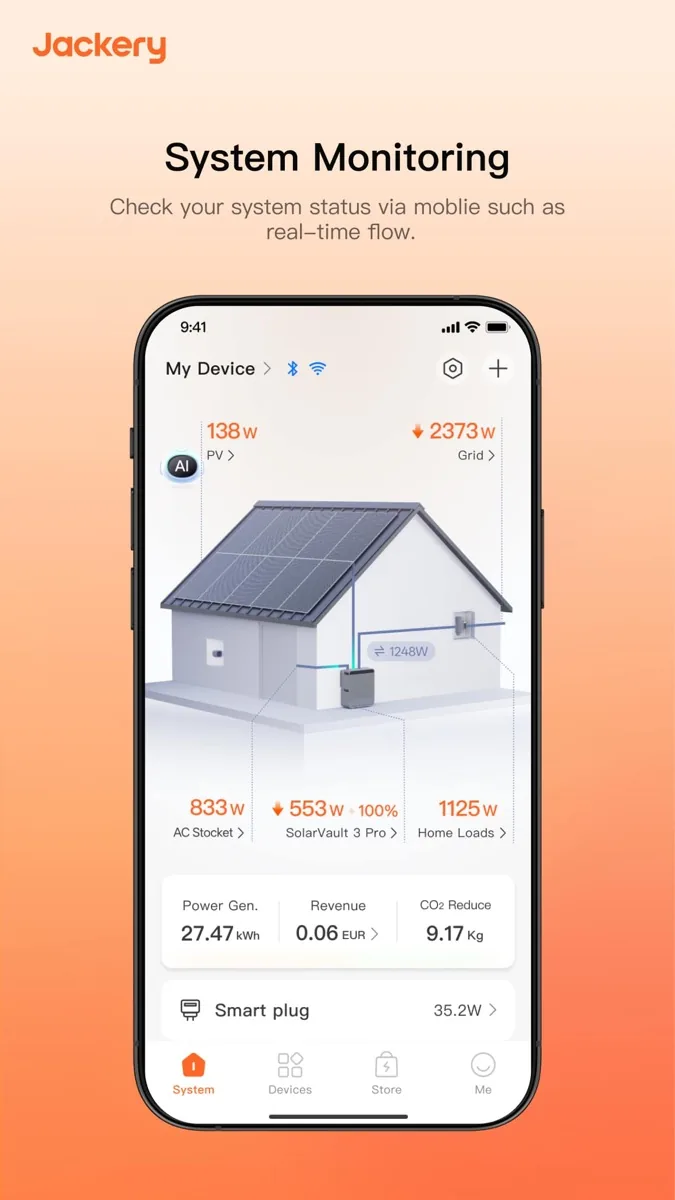
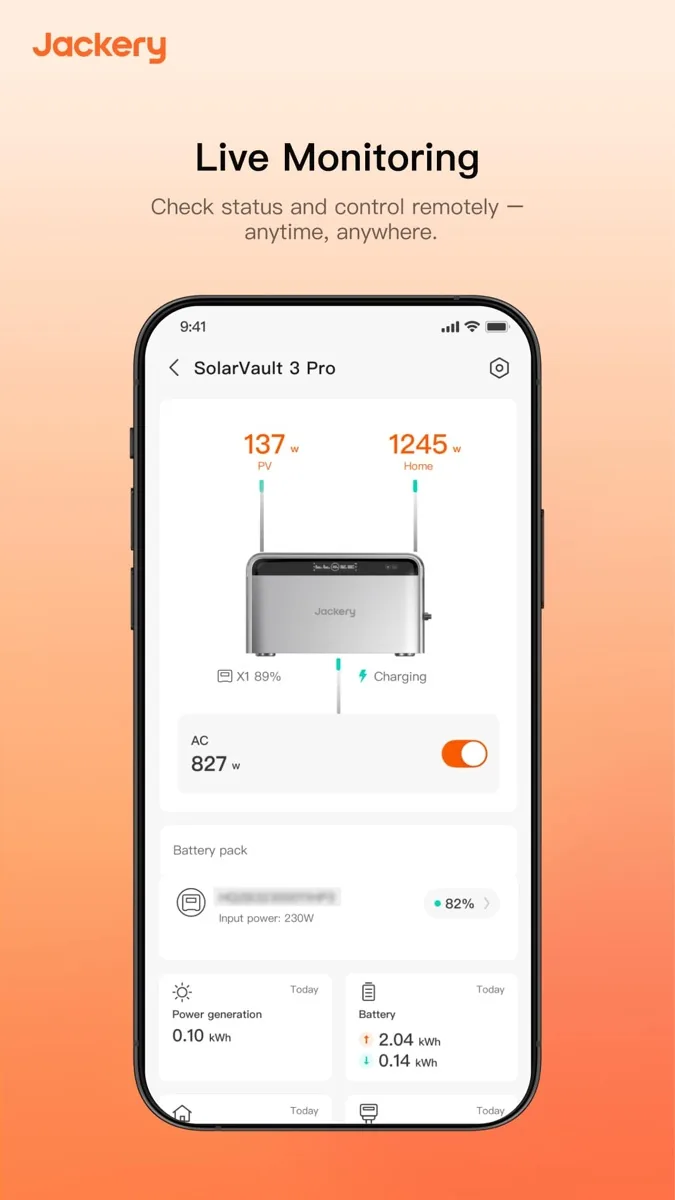
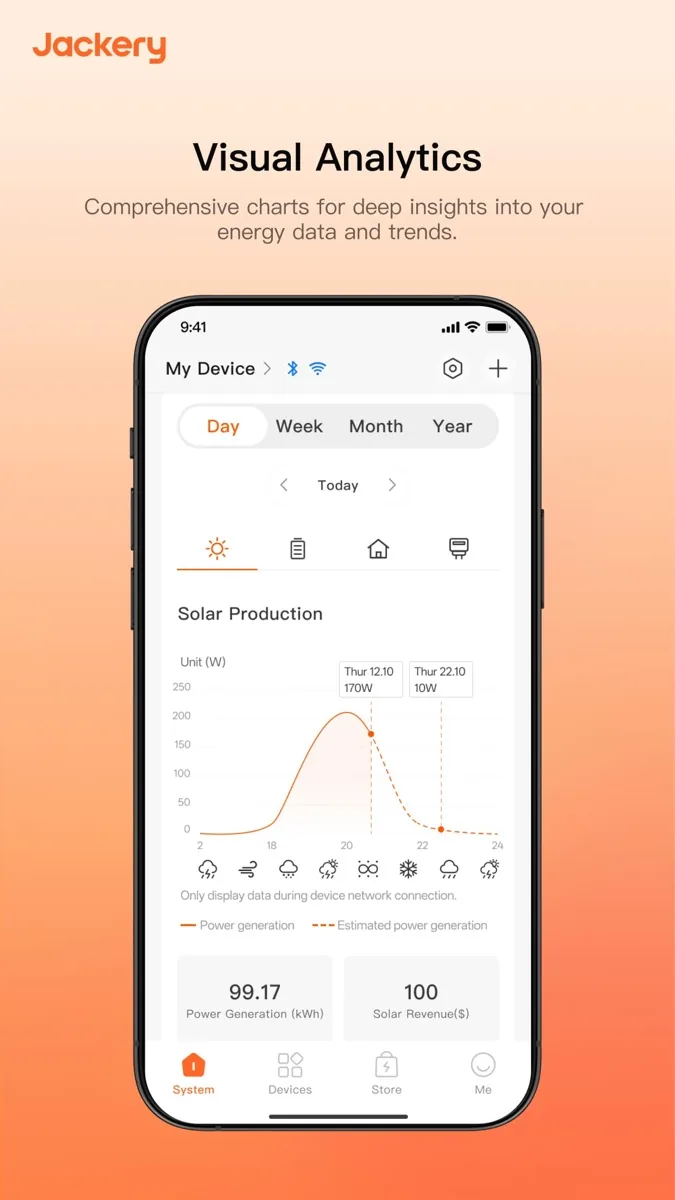
Several current models connect to the Jackery app over Bluetooth or Wi-Fi, which lets you monitor charge level, switch outputs and see estimated runtime, according to Popular Mechanics.
How much does a Jackery cost? Pricing structure
Prices vary with capacity, and we do not list them here; our page shows current prices from our own data. Structurally:
- Capacity drives cost. The small Explorer units cost a fraction of the large HomePower and Explorer 5000 Plus systems.
- Solar generator bundles pair a power station with one or more panels.
- Expansion batteries are sold for the modular models.
- Refurbished units are sold directly by Jackery.
- Extended warranties are sold separately for some large units.
Jackery's range page also lists a 30-day money-back guarantee and free shipping on direct orders.
Is Jackery safe? Recalls, warranty and support
Recalls
We searched the US Consumer Product Safety Commission's recall database for Jackery and found no Jackery recall listed. That is a good sign, but the category as a whole has had problems: the CPSC has announced recalls of power stations from other brands for fire and burn hazards, including an EcoFlow model and a Goal Zero model. Whichever brand you buy, register the product so the maker can contact you, keep it away from heat and water unless it is rated for them, use the supplied chargers, and check cpsc.gov periodically.
Connecting a power station to your home wiring is a different matter from plugging appliances into it. Jackery sells transfer switches and an installation service for its home backup systems; any connection to a home's electrical panel should be done by a licensed electrician.
Warranty
Jackery's range page advertises up to a five-year warranty on purchases made at Jackery.com, with paid extended cover available for some larger units. The length varies by model and by where you buy, so check the product page and keep proof of purchase. Units bought from third-party sellers may carry different terms.
What other reviewers found
- Wirecutter picks the Explorer 300 as its compact choice, saying it offers more power for its size and price than any model it has assessed. Its long-term testers found one unit still held 69 percent of its charge after more than a year in a garage. Wirecutter also said the Explorer 1000 v2 has better battery life for its size than its other picks, but a less comfortable handle and fewer outlets than most rivals.
- OutdoorGearLab named Jackery's 2,042 Wh Explorer v2 its favourite for extended off-grid camping and measured about 1,710 Wh of usable AC output from it. It gave the Explorer 300 a value award but wished it had a built-in light and a runtime estimate.
- Popular Mechanics reported that the Explorer 1000 v2 ran a full-size refrigerator for over 18 hours in its testing, outlasting other 1,000-watt units it had tried, and praised the HomePower line's size-to-capacity ratio and built-in UPS. It noted that the Explorer 1500 Ultra is expensive and its battery cannot be expanded.
- TechRadar, reviewing an earlier Explorer 1500, praised its reliability and range of outlets but found its fan could get loud because the speed did not scale with load.
Where they agree: Jackery's units are compact for their capacity, easy to use and well suited to camping and outage backup, and its small Explorer 300 is a standout for device charging. Where they differ: on the trade-offs. Wirecutter and OutdoorGearLab point to ergonomics and missing extras on some models, while Popular Mechanics focuses on runtime and the HomePower line's backup features, and TechRadar's older review flags fan noise. For a buyer, the practical step is to work out the wattage and run time you actually need, then pick the smallest Jackery that covers it with some headroom, because extra capacity adds both weight and cost.
What could be better
- Usable capacity is lower than the label. Inverter losses mean you get less than the rated watt-hours from the AC outlets, as OutdoorGearLab's measurement shows.
- Small units lack extras. No built-in light or runtime estimate on the Explorer 300.
- Ergonomics on some models. Wirecutter found fewer outlets and a less comfortable handle on the Explorer 1000 v2.
- Weight at the top end. The Explorer 5000 Plus weighs more than 130 lb and is not portable in the everyday sense.
- Warranty varies. Terms depend on the model and where you buy it.
Who should choose something else
- People who only need to charge phones may be better off with a power bank.
- Homes that need days of whole-house power may be better served by a permanently installed battery system or a standby generator installed by a professional.
- Budget buyers may find similar capacity for less from other brands, at some cost in ecosystem and support.
- Anyone relying on power for medical equipment should speak to the equipment's supplier and their healthcare provider about backup needs, and not rely on a portable unit alone.
Bottom line: is Jackery worth it?
For campers, travellers and households preparing for outages, Jackery offers the most complete and best-reviewed range of portable power stations we have assessed, which is why it tops our list. Its current models use long-life LiFePO4 batteries, independent testers keep recommending its small and mid-size units, and we found no Jackery recall in the CPSC database. Size your purchase to your real needs, check the warranty term for the specific model, and treat any home wiring connection as a job for an electrician.
Frequently asked questions
Which Jackery power station should I buy?
Start with what you need to power and for how long. The Explorer 300 suits phones, laptops and small devices. Units around 1 kWh suit camping and short outages. The 2 kWh class can keep a fridge and essentials running for longer, and the HomePower and Explorer 5000 Plus systems are for extended home backup. Add up appliance wattages and leave some headroom.
What battery do Jackery power stations use?
Every model on Jackery's current power station range page uses a LiFePO4, or lithium iron phosphate, battery. This chemistry is generally rated for many more charge cycles than older lithium-ion types; Popular Mechanics reports the Explorer 1000 v2 is rated for more than 4,000 cycles. Older or refurbished Jackery units may use different chemistry, so check the specification before buying.
Have Jackery power stations been recalled?
When we searched the US Consumer Product Safety Commission recall database, we found no Jackery recall listed. Power stations from some other brands have been recalled for fire and burn hazards, so it is worth registering any unit you buy, using only the supplied chargers, storing it away from heat and checking cpsc.gov from time to time for new notices.
How long is the Jackery warranty?
Jackery advertises up to a five-year warranty on products bought directly from Jackery.com, and sells paid extended cover for some larger units. The exact term depends on the model and where you buy it, and third-party sellers may offer different terms. Check the product page before ordering and keep your proof of purchase for any claim.
Can a Jackery power my whole house?
Smaller Jackery units cannot. The larger systems, such as the Explorer 5000 Plus and HomePower range, are designed for home backup and can be expanded with extra batteries, and Jackery sells transfer switches for connecting to home circuits. Any connection to your electrical panel should be installed by a licensed electrician, and run time will depend on what you power.
Sources
- Portable power stations, Jackery
- Recalls, U.S. Consumer Product Safety Commission
- EcoFlow Technology Recalls Delta Max Power Stations, U.S. Consumer Product Safety Commission
- Goal Zero Recalls YETI 3000X Power Stations, U.S. Consumer Product Safety Commission
- The best portable power stations, Wirecutter
- The best power stations, OutdoorGearLab
- Trying to pick a Jackery power station? Start with these models, Popular Mechanics (via Yahoo Tech)
- Jackery Explorer 1500 review, TechRadar