

Our verdict
This Private Internet Access review looks at PIA as a whole and at MACE, the ad, tracker and malware blocker built into its apps, since that is why it appears in our ad blocker rankings. PIA is one of the longest-running consumer VPNs, and its reputation rests on privacy credentials that few rivals can match: open-source apps, RAM-only servers, regular transparency reports showing no logs handed over, independent no-logs audits and, unusually, court cases in which it had no user activity data to produce. One subscription covers an unlimited number of devices, and the apps are among the most configurable available.
As an ad blocker, MACE is best understood as a privacy and safety layer rather than a full replacement for a browser extension. It filters known ad, tracking and malicious domains at the network level, which cuts clutter and blocks many dangerous sites across every app on a device. By design it cannot remove every ad, and PIA itself says VPN-based blockers are usually not effective against ads on large video platforms. Pair it with a browser blocker if a completely ad-free page is the goal.
NerdBible did not run its own speed or blocking tests for this review. It is an editorial assessment based on PIA's own feature, privacy and transparency pages, and on reviews from PCMag, TechRadar and Tom's Guide, each credited where used.
What is Private Internet Access and who is it for?
PIA's privacy policy names the company as PIA Private Internet Access, Inc., based in Denver, Colorado. PCMag notes that PIA is owned by Kape Technologies, which also owns CyberGhost and ExpressVPN, and that Kape, in an earlier form under a different name, faced accusations of being an adware platform. PCMag says PIA confirmed its VPN infrastructure is kept separate from other Kape properties.
PIA suits:
- Privacy-focused users who want a no-logs policy that has been tested in court and audited, and apps whose code anyone can inspect.
- Large households and device-heavy users. The PIA homepage advertises unlimited simultaneous connections on one subscription.
- Tinkerers. PIA exposes protocol, encryption and routing settings that most VPNs hide.
- People who want fewer ads and trackers system-wide, not just in one browser, with MACE switched on.
It suits less well people who want the fastest possible connection, people who want a simple app with almost no settings, and anyone who wants a dedicated, full-strength ad blocker on every site.
Key features
- Unlimited devices. One account, any number of simultaneous connections, according to PIA.
- Large server network. PIA says it runs RAM-only servers in 104 countries. PCMag reports that roughly half of all servers are virtual locations, which PIA clearly labels on its server list.
- Modern protocols. PCMag reports that OpenVPN and WireGuard are available on all platforms, with IKEv2 as an extra option on iOS, and that PIA lets you adjust advanced settings for each.
- Kill switch. A standard kill switch that cuts the connection if the VPN drops, plus an advanced mode that blocks all traffic unless PIA is connected.
- Split tunnelling and multi-hop. PCMag lists advanced split tunnelling and a proxy-based multi-hop option among PIA's strengths.
- Open-source apps. PIA says its apps are 100% open source, so anyone can review the code.
- Dedicated IP add-on. A paid option for an IP address only you use, which PIA says can mean fewer CAPTCHAs and more stable logins to services such as online banking.
- MACE. The built-in blocker for ads, trackers and malware domains, covered in detail below.
How good is PIA's ad blocker? MACE explained
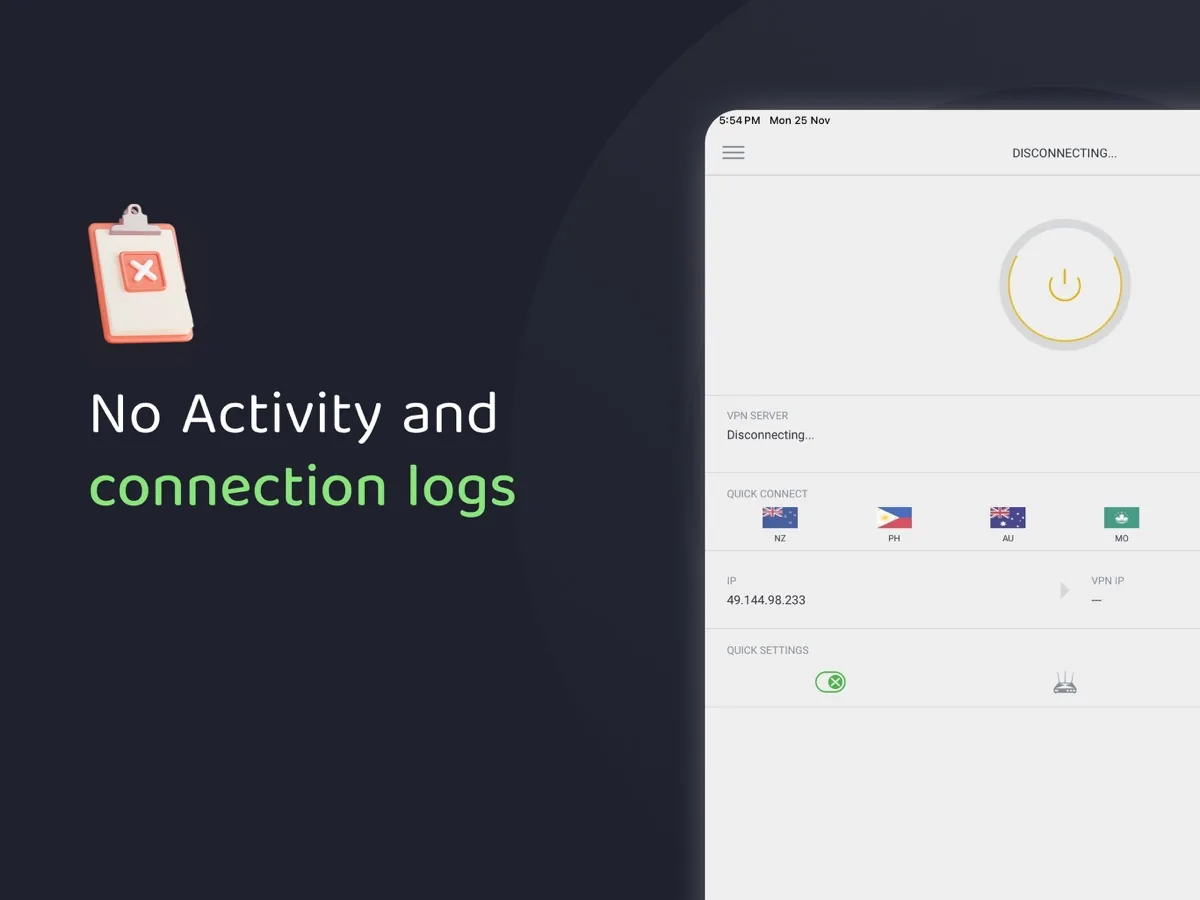
PIA's MACE page describes the feature as DNS-level blocking. When an app or browser on your device looks up a web address, the request goes to PIA's DNS servers, which refuse to resolve domains on its block lists of advertisers, trackers and sites linked to malware and phishing. PIA says MACE focuses mainly on malicious domains while allowing some ads through, and positions it as a lightweight alternative to browser extensions that can also save data and battery.
The strengths of this approach are real. MACE works across every app on the device rather than only in one browser, it needs no configuration beyond a single toggle, and it adds protection against known phishing and malware hosts. PIA lists MACE on its Windows, macOS, Android and Linux apps and on its Chrome and Opera extensions; iOS is not on that list.
The limits matter just as much. A TechRadar explainer on MACE notes that when ads are served from the same domain as the content, DNS blocking cannot remove them without breaking the site, and it gives YouTube as the classic example. PIA's own MACE page agrees, saying that VPN ad-blocking features are usually not effective against YouTube ads. PCMag adds that MACE cannot be configured per site, so there is no allow-list for websites you want to support. The practical setup for most people is MACE for network-wide tracker and malware filtering, plus a reputable browser extension for cosmetic ad removal.
How much does PIA cost? Plans and structure
Prices on this page come from NerdBible's own data, so here is the structure. PIA sells a monthly plan and longer multi-year plans, and the longest plans carry by far the lowest effective monthly cost, which is why PCMag lists the monthly plan as expensive while other reviewers call PIA excellent value. There is no free version. The homepage says all plans carry a 30-day money-back guarantee for new subscribers, while purchases made through the Apple App Store or Google Play follow those stores' refund rules instead. Add-ons such as a dedicated IP are billed on top.
Is PIA safe? Privacy, audits and logs
This is PIA's strongest area. Its no-logs page says its policy has been tested in a US court on more than one occasion, with PIA unable to provide usage information about users, and that independent audits by Deloitte concluded it does not collect or store VPN data that could identify you. The page also highlights RAM-only servers, which do not keep data on disk.
The transparency report is published quarterly and lists legal requests received by type, including subpoenas and warrants, alongside the number of logs produced: zero in every category of the latest report. The privacy policy says PIA needs only an email address and payment to open an account, collects anonymised aggregate data such as server load and bandwidth capacity, and does not sell personal data.
Two caveats. First, PIA is a US company, and some privacy-minded users prefer providers based elsewhere; its court record is the strongest counter-argument. Second, TechRadar notes that the full Deloitte audit report is available only to PIA customers rather than published openly.
What could be better?
- Speed. TechRadar and Tom's Guide both found PIA slower than the fastest VPNs, especially on OpenVPN.
- Support. TechRadar found support responses could be slow, and Tom's Guide found some help articles out of date.
- Pace of development. Tom's Guide feels PIA has added fewer new features recently than its rivals.
- MACE limits. No per-site controls, no iOS support listed, and no effect on ads served from a site's own domain.
- Complexity. The number of settings can overwhelm beginners, though the default view stays simple.
Who should choose something else?
If the main goal is removing ads in your browser, a dedicated ad-blocking extension will do more on its own than MACE, and many are free. If you want the fastest VPN for large downloads or calls over long distances, look at the providers that lead current speed tests. If you prefer a provider based outside the United States, choose one of those. And if you want an app with almost no options, a simpler VPN may feel friendlier.
Private Internet Access review bottom line: is PIA worth it?
Yes, especially on a longer plan. PIA combines unlimited devices, open-source apps, RAM-only servers, quarterly transparency reports and a no-logs policy backed by both court records and audits, which is a rare set of credentials in this market. MACE is a genuinely useful addition that blocks many trackers and malicious domains across your whole device. Just treat it as one layer of an ad-blocking setup rather than the whole thing, and you will get the most from both the VPN and the blocker.
What other reviewers found
- PCMag called PIA a robust VPN with advanced features and a commitment to transparency, crediting its unlimited connections, open-source code and repeated third-party audits, while listing the monthly price and lack of a free version as drawbacks.
- PCMag also measured a moderate speed loss and described MACE as a one-click blocker without per-site settings.
- TechRadar described PIA as a privacy-first provider offering a lot for the money, but said it lacks some newer innovations, scored its speeds as middling and found support slow at times.
- Tom's Guide praised its audited no-logs policy, transparency reports, open-source apps and record of resisting official requests for user data, but found connections relatively slow and support material increasingly dated.
Where they agree: PIA's privacy record is among the best in the industry, unlimited devices is a standout, the apps are highly configurable, and raw speed is not its strength.
Where they disagree: value and the audit record. PCMag calls it expensive while TechRadar calls it great value; the difference is the plan length each assumes. TechRadar and PCMag count three Deloitte audits, while PIA's own no-logs page refers to two. For a buyer, the conclusion is the same either way: the no-logs policy has been checked repeatedly by an outside firm and tested in court, which is stronger evidence than most rivals offer, and a long plan is where the value lies.
Frequently asked questions
Does PIA block ads?
Yes, through its built-in MACE feature, which blocks known ad, tracker and malware domains at the DNS level across the apps on your device. It is not a complete ad blocker: ads served from the same domain as a site's content, as on large video platforms, get through, and PIA itself says VPN ad blockers are generally not effective against YouTube ads. Use a browser extension alongside it.
Is Private Internet Access safe to use?
Yes. PIA's no-logs policy has been tested in US court cases and checked by Deloitte audits, its apps are open source, its servers run in RAM only, and its quarterly transparency reports show no logs produced in response to legal requests. The main consideration is that PIA is a US company owned by Kape Technologies, which some privacy-focused users weigh up.
How many devices can I use PIA on?
PIA allows unlimited simultaneous connections on one subscription, according to its website. That makes it one of the most practical choices for large households or anyone with many phones, laptops and tablets. Router setup is also supported, which can extend protection to devices that cannot run the PIA app, such as some smart TVs and games consoles.
Does PIA have a free trial or money-back guarantee?
PIA has no free version, but its website says all plans include a 30-day money-back guarantee for new subscribers. If you buy through the Apple App Store or Google Play, refunds follow those stores' own rules instead. Try the apps, check speeds and MACE on the devices you use most, and request a refund within the window if it does not suit you.
Who owns Private Internet Access?
PIA is operated by PIA Private Internet Access, Inc., based in Denver, Colorado, and is owned by Kape Technologies, which also owns CyberGhost and ExpressVPN. PCMag reports that PIA confirmed its VPN infrastructure is kept separate from other Kape properties. The ownership does not change PIA's audited no-logs policy, but it is worth knowing when comparing VPNs.