
This Teen Counseling review is written for parents and guardians weighing whether an online therapy platform is a sensible way to get their teenager talking to a licensed professional. Teen Counseling is the adolescent service run by BetterHelp, and it connects young people aged 13 to 19 with a licensed counsellor by messaging, live chat, phone or video, with a parent or guardian setting up the account. NerdBible has not used the service with a teen of our own. This is an editorial assessment based on Teen Counseling's own pages, guidance from the National Institute of Mental Health and the 988 Suicide and Crisis Lifeline, a Federal Trade Commission order against its parent company, and the findings of independent reviewers. Nothing here is medical advice: if you are worried about your child, speak to their doctor or another qualified professional.
Our verdict
Teen Counseling is a convenient, well-structured way for a teenager to get regular, private contact with a licensed counsellor without a waiting list or a commute, and it is one of the few large platforms built specifically around the parent and teen relationship. The setup is sensible: the parent signs up and consents, the teen joins with a code, and each has a separate, private conversation with the counsellor. Therapists must be licensed and experienced, sessions can happen by text, phone or video, and the subscription can be cancelled at any time. The limits are just as important. Counsellors on the platform cannot diagnose, cannot prescribe, do not take insurance and do not handle crises or court orders. Customer reviews are noticeably more mixed than the professional ones, mostly about billing and therapist responsiveness. For a teen with everyday stress, low mood, family friction or school pressure who is more comfortable typing than sitting in an office, it is a reasonable first step. For anything more serious, it should sit alongside in-person care, not replace it.
What it is and who it is for
Teen Counseling is part of BetterHelp, which describes itself as the world's largest therapy service, and it draws on the same large network of licensed professionals. The service is designed for young people aged 13 to 19. A parent or guardian creates the account, answers questions about the teen's needs, gives consent, and then invites the teen with a sign-up code. The platform matches the family with a counsellor based on those answers.
It is designed for the kind of concerns many families face: stress, anxiety, low mood, self-esteem, relationships, bullying, family conflict and school pressure. Independent reviewers note that it can be especially useful for a teen who would not see a school counsellor for fear of being noticed, or who finds it easier to write than to speak.
It is not designed for emergencies. Teen Counseling's own home page tells anyone in a crisis, or anyone who may be in danger, not to use the site. In the US, the 988 Suicide and Crisis Lifeline is free, confidential and available around the clock by call, text or chat, and the NIMH advises families to save that number in their phones.
Key features
Separate, private rooms for parent and teen
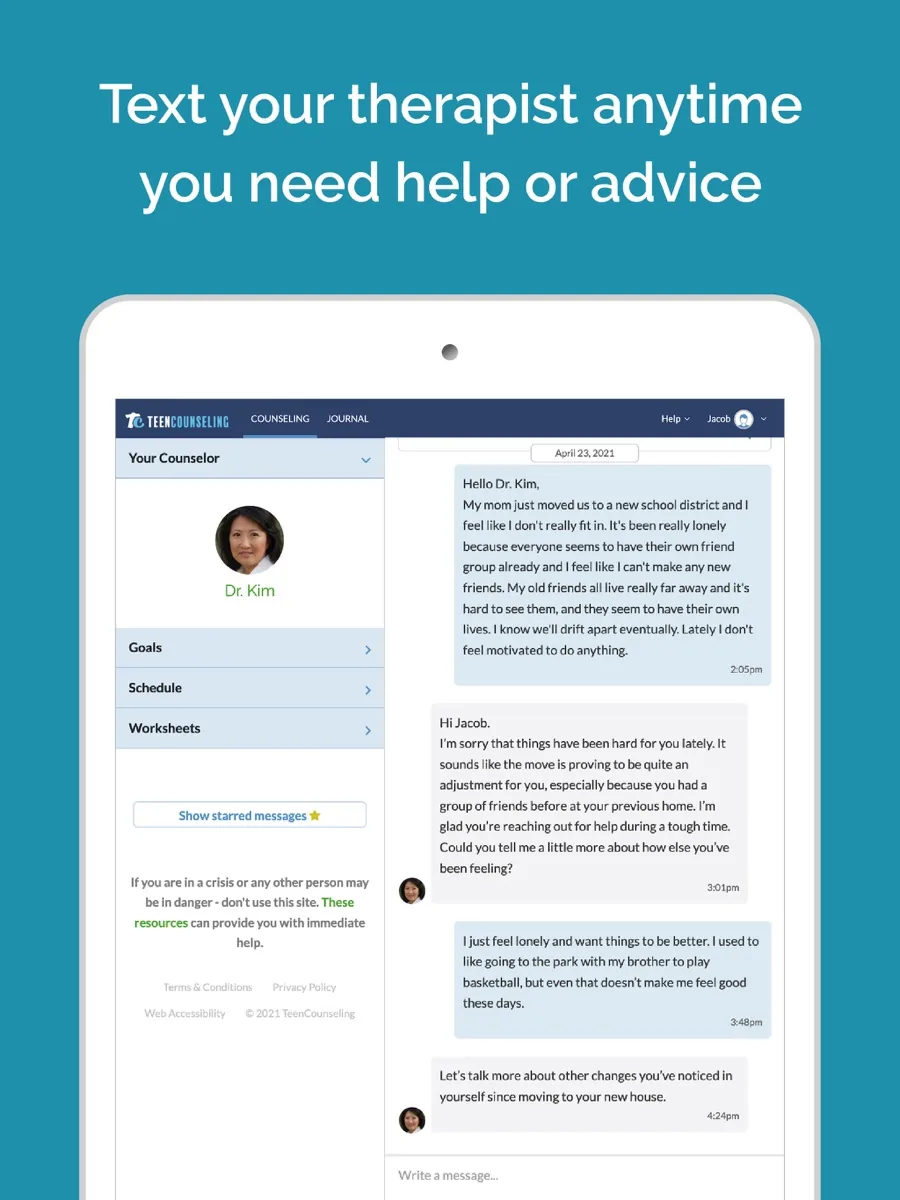
The parent FAQ explains that the parent's and the teen's messages to the counsellor are kept separate, so neither can read the other's conversation. Parents cannot join the teen's sessions but can speak with the counsellor separately. Teen Counseling says therapy stays between the counsellor and the user unless there is a concern about serious risk. That is the right balance for most families, because a teenager who suspects a parent is reading along is unlikely to open up.
Four ways to talk
Teens can message their counsellor at any time, and schedule live sessions by chat, phone or video. Teen Counseling says live sessions usually run 30 to 45 minutes. Choosing Therapy's reviewer reported that counsellors aim to answer messages within about a day and that matching usually took 24 to 48 hours. Messaging is not instant support: a reply may come hours later.
Licensed, experienced counsellors
The FAQ lists the qualifications it accepts, including psychologists, licensed marriage and family therapists, clinical social workers and licensed professional counsellors, and says each must hold a state licence and have at least three years and 1,000 hours of hands-on experience. The home page puts the network at more than 9,000 therapists. It is fair to note that this is BetterHelp's shared network rather than a group of adolescent specialists only, so it is worth asking the matched counsellor about their experience with teenagers, and switching if the fit is not right.
Easy switching and cancellation
Families can request a different counsellor at any time, and the subscription can be cancelled whenever they choose. Several reviewers point out that the switch can matter more than anything else: the first match is not always the right one.
Available across the US
Choosing Therapy reports that the service is available in all 50 states. Some Trustpilot reviewers outside the US say they were matched with American counsellors whose session times did not suit their time zone, so families elsewhere should check availability first.
How much does Teen Counseling cost?
Our card above shows current pricing from our data; here is how the billing works. Teen Counseling charges a recurring subscription that covers messaging and live sessions, and the FAQ says the price varies within a weekly range depending on location, preferences and therapist availability. Billing is recurring rather than per session, and it can be cancelled at any time. The service does not accept insurance and does not file claims, and the FAQ says services are generally not covered by health insurance, Medicare or Medicaid. HSA and FSA cards can be used. Because counsellors do not diagnose, Choosing Therapy notes that families cannot get a superbill to claim out-of-network reimbursement either. Psych Central reported that refunds are not offered after a billing period has been charged, so cancel before the renewal if you decide to stop.
Is Teen Counseling safe?
There are two questions here: is it safe for a teen to use, and is the family's data safe.
On the first, the structure is reassuring. Counsellors are licensed, a parent must consent, the teen's conversation is private, and the service is clear about what it will not do. Teen Counseling tells users not to rely on the site in a crisis. Parents should still treat it as one part of a support network rather than the whole of it. The NIMH lists warning signs in adolescents, including withdrawal from friends, changes in sleep or eating, self-harm, substance use and talk of suicide, and advises parents who see them to contact a paediatrician, family doctor or school counsellor. Those steps apply whether or not a teen is in online therapy.
On data, there is a history to know about. The FTC finalised an order requiring BetterHelp to pay 7.8 million dollars and banning it from sharing consumers' health data for advertising, after alleging that it had passed email addresses, IP addresses and health questionnaire answers to platforms including Facebook and Snapchat despite promising privacy. The FTC's refund programme explicitly covered people who paid for Teen Counseling, alongside BetterHelp's other sites. The order now bars that kind of sharing and requires a privacy programme, but Healthline listed its sister company's privacy history as a reason some families may hesitate. Read the current privacy policy before signing up, and talk with your teen about what they share.
What could be better
- No diagnosis, prescribing or insurance. Counsellors on the platform cannot diagnose a condition or prescribe, so a teen who may need an assessment or medication will need a separate in-person provider. That also rules out insurance claims.
- No choice of first counsellor. Psych Central points out that families are matched rather than choosing from profiles, although they can switch afterwards.
- Uneven responsiveness. Professional reviewers and customers both describe a wide range, from counsellors who answer quickly and connect well with teens to ones who are slow or miss sessions.
- Billing complaints. Teen Counseling's Trustpilot score was 2.2 out of 5 from about a hundred reviews when we checked, a sharp contrast with professional ratings. Most of the one-star reviews are about continued charges after a teen stopped using the service and slow email-only support. Set a reminder to cancel if your teen stops engaging.
- Not for court orders or crises. The FAQ says the service cannot fulfil court-ordered therapy and is not suitable for emergencies.
Who should choose something else
Choose in-person or insurance-covered care if your teen may need a diagnosis, a medication review, intensive treatment, or support after a crisis. A paediatrician or family doctor can refer you, and many insurers now cover video therapy with in-network providers, which may cost less than a cash-pay subscription. If your teen is at school, the school counsellor is a free first point of contact. And if there is any immediate risk, call or text 988 or your local emergency number rather than any app.
Families who want a counsellor who can see the whole family together regularly may prefer a local family therapist, because Teen Counseling keeps parent and teen conversations separate by design.
Teen Counseling review: what other reviewers found
- Healthline named Teen Counseling its pick for teens, and its teenage tester felt the counsellor spoke to her in an age-appropriate way; it flagged the lack of insurance and BetterHelp's privacy history as downsides.
- Psych Central liked the flexible ways to communicate and the option to switch counsellors, but listed matching instead of choosing, variable counsellor responsiveness and no refunds once a month is charged as drawbacks.
- Choosing Therapy gave it 3.5 out of 5 after a session, finding the counsellor clear about involving parents, and noted fast matching but no diagnosis, no medication management and no insurance.
- Parents on Trustpilot are split almost down the middle, with praise for convenience and good matches set against complaints about billing, unresponsive counsellors and limited customer support.
Where the reviews agree and disagree
The professional reviewers broadly agree on what Teen Counseling does well: it is easy to set up, it offers several ways to talk, it respects the teen's privacy while keeping the parent involved, and it lets families switch counsellors. They also agree on the boundaries: no diagnosis, no prescribing, no insurance and no crisis care.
They differ in emphasis. Healthline's teen tester had a positive experience and the outlet named it a top pick, while Choosing Therapy's lower score reflects the cost of paying privately for a service that cannot diagnose. Psych Central lands in between, positive about the format but cautious about consistency.
The biggest gap is between editors and paying families. Professional reviews are generally favourable, while Trustpilot reviews are polarised, and the negative ones are mostly about money and responsiveness rather than about therapy itself. For a buyer, the lesson is practical: the quality of the experience depends heavily on the individual counsellor, so check in with your teen after the first few weeks, switch if the fit is poor, and keep an eye on renewal dates.
Is Teen Counseling worth it?
For many families, yes, as a first step. Teen Counseling removes the biggest barriers to a teen talking to a professional: travel, waiting lists, and the awkwardness of a face-to-face first meeting. Its parent-consent model and private rooms are well thought through, and its counsellors are licensed and experienced. It is worth it if you go in clear about its limits, keep the 988 Lifeline and your child's doctor in the picture, and watch the billing. If your teen needs diagnosis, medication or crisis support, start with their doctor instead.
Frequently asked questions
Is Teen Counseling legit?
Yes. Teen Counseling is operated by BetterHelp, one of the largest online therapy companies, and it says every counsellor holds a state licence and has at least three years and 1,000 hours of hands-on experience. Professional reviewers including Healthline and Psych Central describe it as a genuine service. Customer reviews are more mixed, mainly about billing and responsiveness rather than about whether the counsellors are real professionals.
Can parents read their teen's messages on Teen Counseling?
No. Teen Counseling keeps the parent's and the teen's conversations separate, so neither can read what the other has written to the counsellor. Parents can talk to the counsellor in their own room but cannot join the teen's sessions. The service says therapy stays between the counsellor and the user unless there is a concern about serious risk, which a counsellor may need to act on.
Does Teen Counseling take insurance?
No. Teen Counseling's FAQ says its services are generally not covered by health insurance, Medicare or Medicaid, and it does not submit claims. Families pay a recurring subscription instead, which can be cancelled at any time, and HSA or FSA cards can be used. Because counsellors do not diagnose, reviewers note there is no superbill for out-of-network reimbursement either.
What ages does Teen Counseling serve?
Teen Counseling is designed for young people aged 13 to 19. A parent or legal guardian creates the account, gives consent and invites the teen with a code, after which the teen has private sessions with the matched counsellor. Choosing Therapy notes that the first session often includes the parent so everyone agrees on expectations before one-to-one sessions begin.
What should we do in a crisis?
Do not rely on Teen Counseling or any messaging app in an emergency; the service itself says not to. In the US, call or text 988 to reach the 988 Suicide and Crisis Lifeline, which is free, confidential and available every hour of every day, or use its online chat. If someone is in immediate danger, call 911 or go to the nearest emergency department.
Sources
- Teen Counseling home page, Teen Counseling (BetterHelp)
- Parent FAQ, Teen Counseling
- Child and Adolescent Mental Health, National Institute of Mental Health
- 988 Suicide and Crisis Lifeline
- FTC Gives Final Approval to Order Banning BetterHelp from Sharing Sensitive Health Data for Advertising, Federal Trade Commission
- BetterHelp Refunds, Federal Trade Commission
- The best online therapy services for kids, Healthline
- Teen Counseling Online Therapy Review, Psych Central
- Teen Counseling Review, Choosing Therapy
- Teen Counseling reviews, Trustpilot